
By Jeremiah Oresanya
There is a shift happening, and it is a good one, one that is set to help Nigeria achieve its industrial and $1 trillion ambition.
Around the world, energy systems are being redesigned at extraordinary speed.
Renewable power capacity is expanding faster than at any point in history, with solar leading the charge.
Demand is also changing. The drivers of power consumption are no longer just households and traditional industries, but now include electric mobility, cloud computing, data centers and manufacturers.
The world is not just watching, it is putting its money where attention is deserved. There is a growing wave of investments and funding backing Nigeria’s renewable energy push.
The federal government, through the Rural Electrification Agency (REA), is leading the charge in partnership with private investors and development partners, all backed by an enabling policy environment.
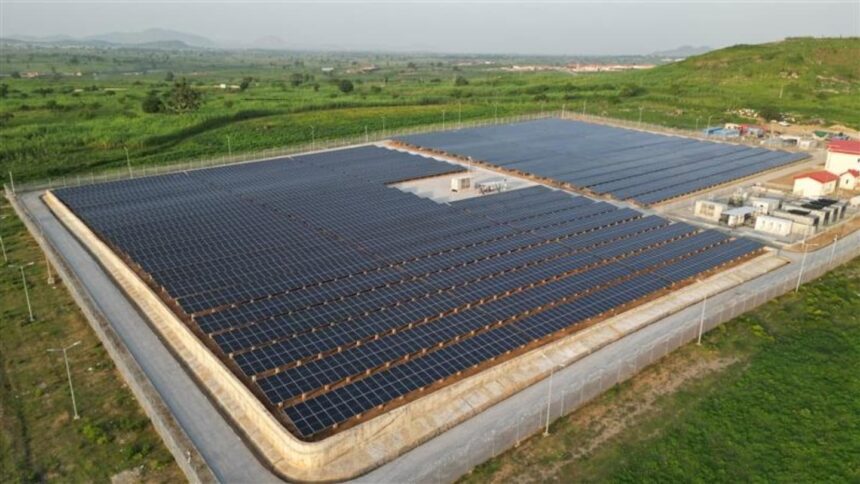
In Niger State recently, the state government officially handed over 500 hectares of land for the development of a 200MW solar power project that will power Abuja Steel Mills.
This 200MW solar-powered industrial energy project is not just about generating electricity; it is about creating a model for how renewable energy can directly support industrial growth, local manufacturing, job creation, and economic transformation.
Similarly, the UNDP under its Africa Minigrids Program (AMP), with funding from the Global Environment Facility (GEF) and in partnership with RMI, the African Development Bank, and the REA has invested over $5.9 million across 23 separate sites in Nigeria.
This funding is particularly interesting as it specifically aims to support women and position them as leaders in the race to achieve sustainable energy.
This injected funding is expected to mitigate approximately 74,000 metric tons of CO_2 over the lifetime of the mini-grid investments by replacing diesel and firewood with solar energy.
It has also transformed the lives and businesses of over 20,000 people.
Furthermore, the International Finance Corporation (IFC), a member of the World Bank Group, in partnership with Norfund, the Norwegian Investment Fund for developing countries through a financing of up to $83.2m is backing five Renewable Energy Service Companies (RESCOs); Darway Coast Nigeria Limited, GVE Projects Limited, Prado Power Limited, PriVida Power Limited, and StarTimes Energy to expand last‑mile power access in communities that remain disconnected from the national grid.
This funding also includes $35.3m in concessional debt drawn from the IDA Private Sector Window Blended Finance Facility and IFC’s Concessional Capital Window.
Together, these initiatives represent an estimated capital expenditure of $271 million, which will fund the deployment of 315 solar hybrid mini-grid sites and connect 2.9 million people to clean electricity.
In the private sector, companies like Sun King see the renewable energy space in Nigeria as not just critical, but highly commercially viable.
In May 2025, Sun King, in partnership with the International Finance Corporation (IFC) of the World Bank Group and Stanbic IBTC Bank, secured an $80 million, fully Naira-denominated loan facility to scale access to off-grid solar energy in Nigeria.
The investment aligns with Nigeria’s Country Partnership Framework with the World Bank Group and contributes to Mission 300, a joint initiative launched with the African Development Bank in 2025 to expand electricity access across Africa.
Commenting at the time, Anish Thakkar, Co-Founder of Sun King, said, “Off-grid solar provides the fastest and most scalable pathway to universal electrification across Africa.”
This collaborative momentum is further mirrored by targeted facilities from players like First City Monument Bank (FCMB), which launched a massive $188 million Green Finance Facility alongside the REA to support broader sustainable infrastructure.
FCMB had also earlier launched a #100bn dual currency funding to supprt energy access expansion across Nigeria.
Other commercial banks like Lotus Bank have also partnered with the REA to launch a dedicated #100billion facility interest free renewable energy financing ensuring that market-tailored credit reaches underserved communities.
More recently, WeLight, arguably Africa’s largest rural electrification company, openly declared that it will be investing in Nigeria by 2027.
Backed by €27 million in funding from the IFC, this reinforces an earlier Memorandum of Understanding (MOU) with the REA to deploy and operate 400 mini-grids and 50 MetroGrids in Nigeria by 2030.
The REA is not attempting to solve every power challenge everywhere at the same time.
The agency is prioritizing locations where reliable power can quickly translate into productivity and revenue, enabling it to embark on more projects to fast-track energy access.
This is the thinking behind the federal government’s “Electricity Growth Zones” areas where electricity supply, economic demand, infrastructure investment, and private capital are deliberately aligned.
The speed of these investments shows us that distributed energy can move faster than traditional infrastructure when economics, enabling policy environments, and technology align.
Solar-plus-storage, embedded generation, and dedicated renewable infrastructure can support our $1 trillion ambition and spark an industrial wave in ways that conventional grid supply alone may struggle to deliver in the short term.
Speaking recently at the LCCI Renewable Energy Outlook Conference, Dr. Abba Aliyu, the Managing Director of the REA, stated, “If Nigeria creates predictable pipelines of mini-grids, public-sector solarization, embedded generation, industrial solar systems, and large renewable projects, manufacturers will have the confidence to invest.”
“If manufacturers invest, projects become cheaper, supply chains become stronger, jobs are created, and the economy captures more value,” he added.
Under Dr. Aliyu’s leadership, the agency is evolving.
Moving away from its past reputation as a vehicle for lawmakers’ constituency projects, it is fast becoming a rallying point as a market-enabling institution.
The agency has built and continues to build the data, standards, project pipelines, demand aggregation models, and financing partnerships that allow the private sector to scale.
A market that cannot see itself clearly cannot attract capital efficiently. The world is paying attention, Nigerians, too, should pay attention to the coming decade, which will be powered by renewables.
Jeremiah is a commentator and a legal finance advisor. He writes from Lagos, Nigeria.