
… at 101% capacity utilisation, Dangote drops production volume to 39.1ml/d as stockpile climbs to 410.7m L
Oredola Adeola
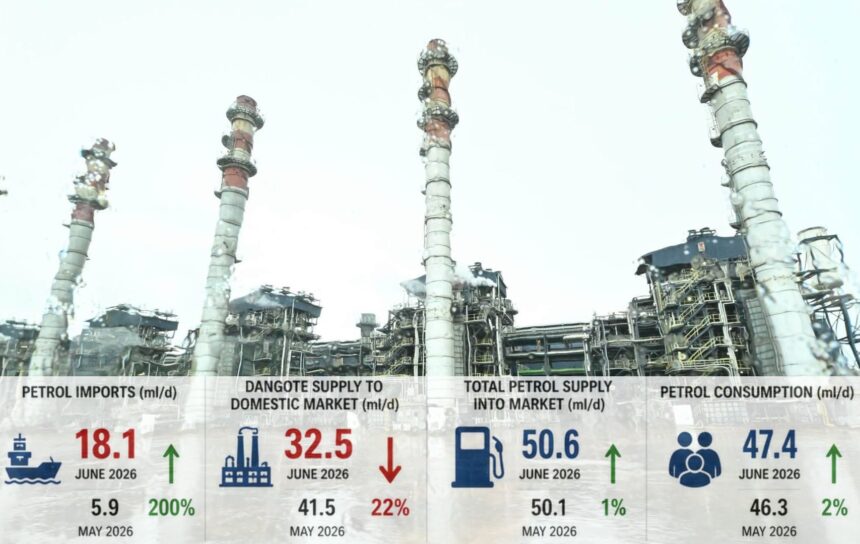
Nigeria’s downstream petroleum market reversed sharply in June 2026, with petrol imports jumping over 200% to 18.1 million litres per day (ml/d) from 5.9 ml/d in May, even as domestic supply from the Dangote Refinery fell by 22% to 32.5 ml/d despite achieving 101.36% average capacity utilisation,.
This was revealed in the latest fact sheet on the state of the midstream and downstream sector released by the Nigerian Midstream and Downstream Petroleum Regulatory Authority (NMDPRA) and analysed by Advisors Reports on Saturday.
Advisors Reports Market Intelligence showed that the surge in importation of petrol marked a near return to January 2026 levels, when marketers brought in as much as 24.8 ml/d.
On the domestic front, supply from the Dangote Refinery declined from a record 41.5 ml/d in May-the highest ever delivered to the local market since the refinery commenced petrol production-highlighting a significant month-on-month contraction in local availability.
Despite these opposing supply movements, total petrol supply into the market remained relatively stable at 50.6 ml/d in June, combining both imported and domestic volumes.
This supported a modest increase in consumption, which rose by 2% to 47.4 ml/d, up from 46.3 ml/d recorded in May.
In June, the Dangote Refinery operated at a slightly higher 101.36% capacity utilisation, yet produced 39.1 ml/d of petrol, down from 44.7 ml/d recorded in May when utilisation stood at 101.25%.
Out of the June output, 32.5 ml/d was supplied to the domestic market, while 3.4 ml/d was exported as at June 30.
This contrasts sharply with May, when virtually the entire 41.5 ml/d production was absorbed locally, with zero importation recorded during the period.
The June shift, lower production, reduced domestic supply, and the re-emergence of exports, coincided with the resurgence in imports, suggesting a recalibration in market allocation, logistics, or commercial strategy rather than a simple decline in refining capability.
Dangote refinery’s inventory boosted as its closing stock rose from just 9.4 million litres as at May 30, 2026 to 410.7 million litres by the end of June, pointing to stock build-up even as domestic supply declined.
While Dangote Refinery continues to operate above nameplate capacity, the divergence between output, domestic supply, and stock levels raises important questions about supply timing, market pricing signals, and the pace of Nigeria’s transition to full import substitution.
Argus Media had in its recent market intelligence reported that In May 2026, both the Nigerian National Petroleum Company (NNPC) Ltd. and Dangote Refinery actively participated in fuel imports, with NNPC bringing in about 11,000 barrels per day (bpd) and Dangote accounting for 27,000 bpd.
This was largely driven by maintenance activities on Dangote’s Residual Fluid Catalytic Cracker (RFCC), which temporarily constrained output and necessitated supplementary imports.
Argus data also showed that total petrol imported by the marketers into Nigeria averaged 57,000 bpd in May, as marketers sourced more petrol from Europe (Norway, Italy, and France).
Advisors Reports’ market intelligence suggest that the petrol import surge witnessed in June is expected to continue into the third quarter of 2026.
This is credited to the fresh import approvals issued by NMDPRA to major marketers, including Matrix Energy, AA Rano, AYM Shafa, Bono, NIPCO, and Pinnacle, that could bring in a combined volume of almost 800,000 metric tonnes of petrol between July and September 2026.
Engr.Bayo Ojulari, Group Chief Executive Officer (GCEO) of the NNPC ltd., on Thursday paid a courtesy visit to the Mallam Rabiu Umar, Authority Chief Executive in Abuja as part of effort of the government’s objectives of increasing domestic energy availability, ensuring supply security, and driving sustainable economic growth.
The NNPC GCEO and ACE during the meeting reaffirmed commitment to working closely to deepen reforms, enhance operational excellence, promote competitive, and sustainable petroleum industry that supports Nigeria’s long-term economic development.