
… GenCos warn intervention covers only fraction of ₦7.66tn liability, recommend cost-reflective tariffs, funded subsidies
Oredola Adeola
Nigeria’s power sector is facing renewed scrutiny as conflicting assessments emerge over the Federal Government’s bond-driven debt resolution strategy, including the ₦501 billion Series-I issuance and the planned ₦729 billion Series-II under the Presidential Power Sector Debt Reduction Programme (PPSDRP).
Both issuances are aimed at settling verified legacy debts owed to electricity generation companies (GenCos), in line with executed Settlement Agreements between the Nigerian Bulk Electricity Trading (NBET) Plc and participating firms.
Government officials say the programme is a critical step toward restoring liquidity across the power value chain.
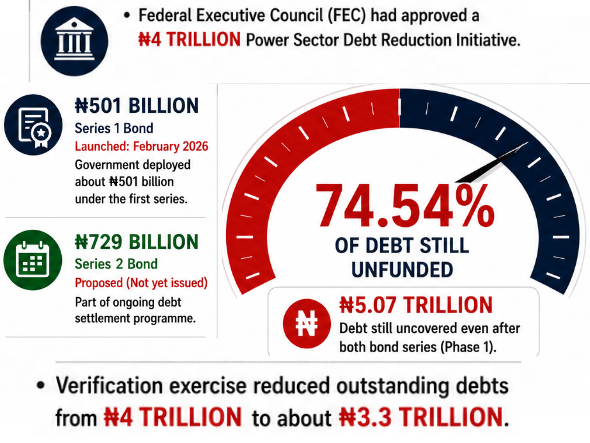
Olu Verheijen, Special Adviser to the President on Energy, said the Series I bond delivered on its objectives, with ₦501 billion, comprising ₦300 billion in cash and ₦201 billion in non-cash instruments, deployed in February 2026 to settle verified obligations.
She disclosed that ₦333.12 billion has been paid to eight GenCos operating 17 power plants, while the first coupon of about ₦63.5 billion on the seven-year bond was fully settled in July 2026, reinforcing government credibility with investors.
Verheijen added that the programme is designed to deepen liquidity and strengthen the sector’s financial base, with Series II expected to scale the impact.
Taiwo Oyedele, Minister of Finance and Coordinating Minister of the Economy, said the Federal Executive Council approved a ₦4 trillion debt reduction initiative following a verification exercise that reduced outstanding claims to about ₦3.3 trillion.
He noted that the second bond issuance, estimated at ₦729 billion, would extend payments to additional GenCos, gas suppliers, and other service providers, completing the first phase of the programme.
However, industry stakeholders argue that the intervention falls significantly short of resolving the sector’s deep-rooted financial challenges.
Dr. Joy Ogaji, Managing Director of the Association of Power Generation Companies (APGC), said total sector debt had risen to about ₦7.66 trillion as of June 2026, stressing that even after both bond series, only about 25.46 percent of the liability would be covered, leaving over ₦5.07 trillion outstanding.
She added that the intervention does not address the persistent monthly revenue gap, estimated at about ₦122.7 billion.
Data from NBET shows that between January and April 2026, GenCos received an average of just 42.5 percent of their monthly invoices, with billing ranging between ₦194 billion and ₦252 billion during the period.
“GenCos are only getting paid about 42.5% of what they invoice each month, leaving an average monthly gap of ₦122.7 billion,” Ogaji said.
She further noted that the sector is also burdened by a ₦1.78 trillion tariff shortfall recorded between April 2025 and April 2026.
According to her, while the bond programme represents a positive first step, it is not a holistic solution to the sector’s liquidity crisis.
Ogaji warned that without structural reforms, including cost-reflective tariffs, improved billing transparency, funded subsidies, and stricter enforcement, the sector’s debt could rise to ₦17.11 trillion by 2033.
She described the situation as a growing financial contagion, cautioning that bonds alone cannot resolve the crisis.