
Advisors ReportsAdvisors Reports
  • News
  • Editorial
  • Feature
  • Special Report
  • Oil & Gas
    • Upstream
    • Midstream
    • Downstream
  • Power
    • Generation
    • Distribution
    • Transmission
  • Renewables
    • Solar
    • Nuclear
    • Hydrogen
  • Extractive Industry
  • Maritime
Search

Archives

  • May 2026
  • April 2026
  • March 2026
  • February 2026
  • January 2026
  • December 2025
  • November 2025
  • October 2025
  • September 2025
  • August 2025
  • July 2025
  • June 2025
  • May 2025
  • April 2025
  • March 2025
  • January 2025
  • December 2024
  • November 2024
  • October 2024
  • September 2024
  • August 2024
  • July 2024
  • June 2024
  • May 2024
  • April 2024
  • March 2024
  • February 2024

Categories

  • Advertorial
  • Concession
  • Distribution
  • Documentary
  • Downstream
  • Editorial
  • Energy Transition
  • Environment
  • Extractive Industry
  • Feature
  • Finance
  • Gas
  • Generation
  • Green Finance
  • Hospitality
  • Hydrogen
  • Hydroplant
  • Impact
  • Interview
  • Local Content
  • Maritime
  • Midstream
  • Mining
  • Mining & Solid Mineral
  • Multilateral Finance
  • News
  • Nuclear
  • Oil
  • Oil & Gas
  • Oil theft
  • Opinion-editorial
  • Photo News
  • Power
  • Renewables
  • Review
  • Sabotage
  • Security
  • Service Company
  • Solar
  • Special Project
  • Special Report
  • Sustainability
  • Technology
  • Transmission
  • Upstream
© 2022 Foxiz News Network. Ruby Design Company. All Rights Reserved.
Reading: Nigeria’s average petrol supply hits 40.1 ML/D in March 2026, as imports drive increase 
Share
Sign In
Notification Show More
Font ResizerAa
Advisors ReportsAdvisors Reports
Font ResizerAa
Search
Have an existing account? Sign In
Follow US
© 2022 Foxiz News Network. Ruby Design Company. All Rights Reserved.
DownstreamMidstreamNewsOil & Gas

Nigeria’s average petrol supply hits 40.1 ML/D in March 2026, as imports drive increase 

admin
admin
Share
3 Min Read
SHARE

…despite strong output at 93.62% capacity, Dangote’s domestic supply falls to 34.2 ML/D for third month

Oredola Adeola

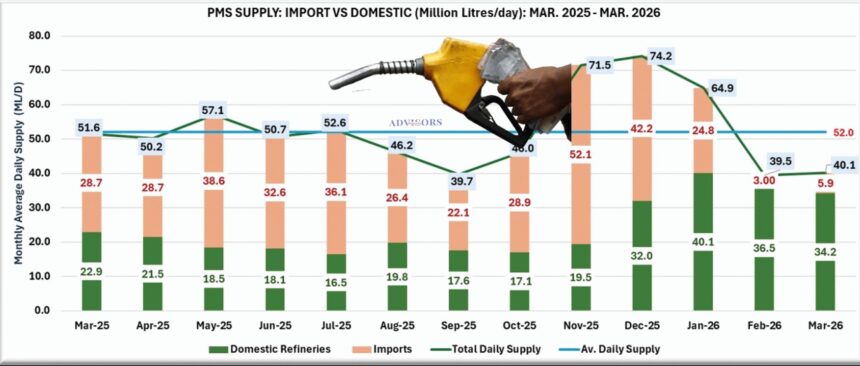
Nigeria’s total petrol supply rose to 40.1 million litres per day (ML/D) in March 2026, up from 39.5 ML/D recorded in February 2026 with domestic supply accounting for 34.2 ML/D and imports contributing 5.9ML/D.

This indicates a recovery in imported petrol volumes in Nigeria, notwithstanding the limited number of licences issued within the period.

- Advertisement -
Ad image

The Nigerian Midstream and Downstream Petroleum Regulatory Authority (NMDPRA) revealed this in its latest factsheet on the state of the midstream and downstream sector and obtained by Advisors Reports.

The data revealed a modest improvement in supply during the review period, even as Nigeria remains heavily reliant on refined products from Dangote refinery, amid global oil market pressures that have driven up refined product prices.

Meanwhile, the factsheet showed that production from the Dangote Refinery recorded output of 48.2 ML/D in March, with an average capacity utilisation of 93.62 per cent.

However, Dangote refinery’s contribution to domestic supply has weakened for the third straight month, declining to 34.2 ML/D in March, compared with 36 ML/D in February and 40.1 ML/D in January 2026.

Meanwhile, petrol import volumes on the other hand nearly doubled on a month-on-month basis, rising to 5.9 ML/D from 3 ML/D in February.

This increase came amid constrained licensing conditions, suggesting a measured re-entry of importers into the market to bridge supply gaps.

On the demand side, domestic consumption eased significantly, dropping to 47.3 ML/D in March from 56.9 ML/D in February.

The decline in consumption, alongside the uptick in supply, indicates a relative easing of market pressure during the review period this is just as average pump price was 1,249.01/ l in Lagos, 1,286.81/ l in Abuja and 1,280.43/L in Enugu.

Overall, the March data showed that imports remain a critical buffer in stabilising supply, as particularly in periods of fluctuating production and demand, amidst the country’s growing dependence on domestic refining capacity.

A supply-demand gap was recorded in March 2026, as total PMS supply of 40.1 ML/D fell short of consumption, which stood at 47.3 ML/D, signaling potential strain on inventories and downstream distribution channels.

On a year-on-year basis, Nigeria’s average daily PMS supply declined sharply to 40.1 ML/D in March 2026 from 51.6 ML/D in March 2025, representing a drop of 11.5 ML/D, or about 22.3 per cent.

However, on a month-on-month basis, supply showed a modest recovery from 39.5 ML/D recorded in February 2026, largely supported by increased petrol imports during the period.




Sign Up For Daily Newsletter

Be keep up! Get the latest breaking news delivered straight to your inbox.
[mc4wp_form]
By signing up, you agree to our Terms of Use and acknowledge the data practices in our Privacy Policy. You may unsubscribe at any time.
Share This Article
Facebook Copy Link Print
Share
Previous Article #ARDAWeek: NMDPRA ACE advocates phased fuel specs harmonisation for Africa to protect supply, consumers
Next Article Developers under DARES, NEP, EEP to gain from new NERC mini-grid regulations – Aliyu, REA MD
Leave a Comment Leave a Comment

Leave a Reply Cancel reply

You must be logged in to post a comment.

Recent Posts

  • MESL operator of Kainji, Jebba hydro power plants launches academy-led SCADA training
  • #OTC2026: Nigeria’s gas flaring falls below 10% as Eyesan reaffirms 2030 elimination target
  • Saudi ADES secures $92.7m offshore drilling contract with Seplat
  • NNPC moves to restart Warri, PH refineries, seals technical deal with Chinese firms for expansion
  • UAE exit puts OPEC cohesion under strain; Nigeria must respond with discipline — Wumi Iledare

Recent Comments

No comments to show.
Follow US
© 2022 AdvisorsReports. All Rights Reserved.
Welcome Back!

Sign in to your account

Username or Email Address
Password

Lost your password?