

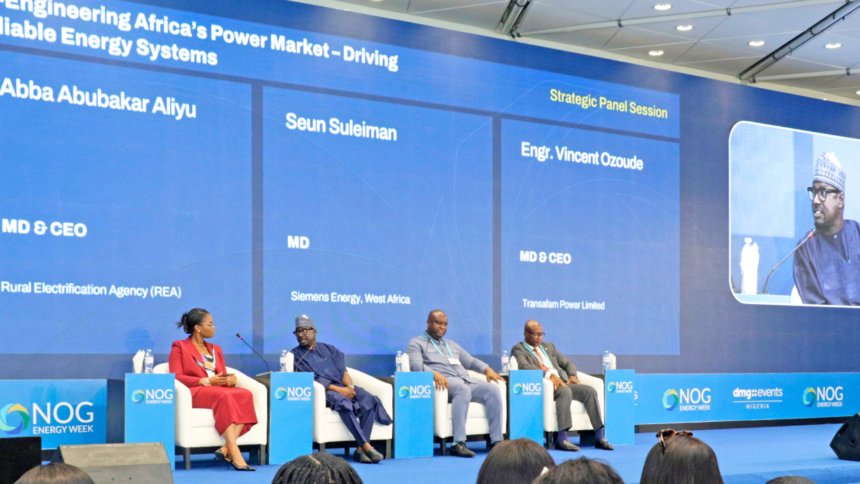
… says Nigeria’s solar portfolio nears 20% of capacity, projects up to 50% share in power mix
Oredola Adeola
The Rural Electrification Agency (REA) has transitioned from a traditional government execution model to a private sector-driven framework, mobilising over $750 million in programme funding to catalyse about $1.1 billion in private investment, alongside additional financing facilities worth hundreds of millions of dollars and tens of billions of Naira.
As the project delivery according to him is led by developers under performance-based structures and the agency playing an enabling role.
He has therefore assured that the solar energy sources in Nigeria have reached a level where it is building a capacity portfolio that is 20% of the total generation capacity, and in the next two, three years, we will continue.
He added that the country would have 50% of the total generation portfolio capacity of the country.
Abba Aliyu, Managing Director and Chief Executive Officer of the Rural Electrification Agency, revealed this while speaking during a panel session at the 25th Nigeria Oil and Gas (NOG) Energy Week 2026 on Thursday.
He noted that the agency has moved away from the traditional government-led contracting approach to a framework that prioritises private sector participation, performance-based incentives, and blended finance structures.
The REA MD revealed that the agency is implementing the Distributed Access through Renewable Energy Scale-up (DARES) programme funding, a $750 million initiative backed by the World Bank, designed to catalyse approximately $1.1 billion in additional private sector investment.
According to him, the programme is structured as a public-private partnership (PPP), deploying results-based financing mechanisms that require private developers to commit capital and meet performance benchmarks before accessing grant support.
Aliyu described the DARES programme as one of the largest renewable energy access initiatives in Sub-Saharan Africa, targeted at accelerating off-grid electrification through mini-grids and standalone solar home systems.
To support implementation, the REA has established financing partnerships aimed at providing bridge funding and improving liquidity for private sector participants.
These include collaborations with the International Finance Corporation (IFC) where financing support is understood to be in the range of approximately $200 million to $250 million, as well as partnerships with financial institutions such as First City Monument Bank (FCMB) which has committed around ₦100 billion in financing facilities.
Additional arrangements, he added, also involved Lotus Bank and Standard Bank, with financing structures estimated around ₦100 billion equivalent per institution, based on industry-standard deal sizes and available programme disclosures.
He emphasised that the programme is designed to de-risk investments and strengthen project delivery, positioning the REA as an enabler of private sector participation rather than a direct executor of infrastructure projects.
“The entire structure is built around the private sector,” Aliyu said, underscoring the agency’s evolving role in facilitating sustainable energy access across the country.
He said, “We have also implemented policy and regulatory interventions to further incentivise private sector participation in the renewable energy space.
“One of the key developments is the revision of the mini-grid regulation by the Nigerian Electricity Regulatory Commission. Previously, developers were limited to deploying mini grids of up to 1 megawatt capacity.
“However, the updated framework now allows for significantly larger systems—up to 5 megawatts for isolated mini-grids and up to 10 megawatts for interconnected mini-grids.
“This is a major step in making the sector more attractive and commercially viable for investors,” he said.
The REA boss emphasised that it is becoming increasingly clear that renewable energy—particularly solar—must be seen as an integral part of Nigeria’s electricity architecture. The earlier this is fully embraced, the better for the sector.
He said, “A few years ago, there was limited confidence in how far solar could scale within Nigeria’s energy mix. Today, that narrative is changing rapidly.
“While renewable energy does not yet account for 20 per cent of Nigeria’s total grid-connected generation capacity, the country is building a rapidly expanding pipeline of solar and distributed energy projects that could significantly increase its share over the next few years.”
“Globally, the trend is unmistakable. Countries such as Tunisia are advancing large-scale solar investments, including projects in the range of 1 gigawatt and above, while Morocco has made significant progress in integrating solar into its energy mix through landmark projects like the Noor solar complex.
“In that country although conventional power still plays a major role, renewables are increasingly shaping the future of electricity generation worldwide.
He therefore emphasised that technology is evolving rapidly, and it is fundamentally reshaping the dynamics of power generation.
He said, “Nigeria must position itself to take full advantage of this transition.”