

… warns of systemic risks as concentrated storage infrastructure threatens nationwide fuel supply stability
…expresses concern over overdependence on Southern-based production, says AKK pipeline will shift industrial base
Oredola Adeola
Rabiu Umar, Chief Executive of the Nigerian Midstream and Downstream Petroleum Regulatory Authority (NMDPRA), has unveiled plans to develop a national framework for deploying product buffers across strategically located depots and tank farms, aimed at enhancing supply flexibility and safeguarding against disruptions such as a potential Strait of Hormuz closure.
He warned that the continued concentration of storage infrastructure in limited regions poses systemic risks, noting that localized disruptions could trigger nationwide supply shortages and repeated stock imbalances.
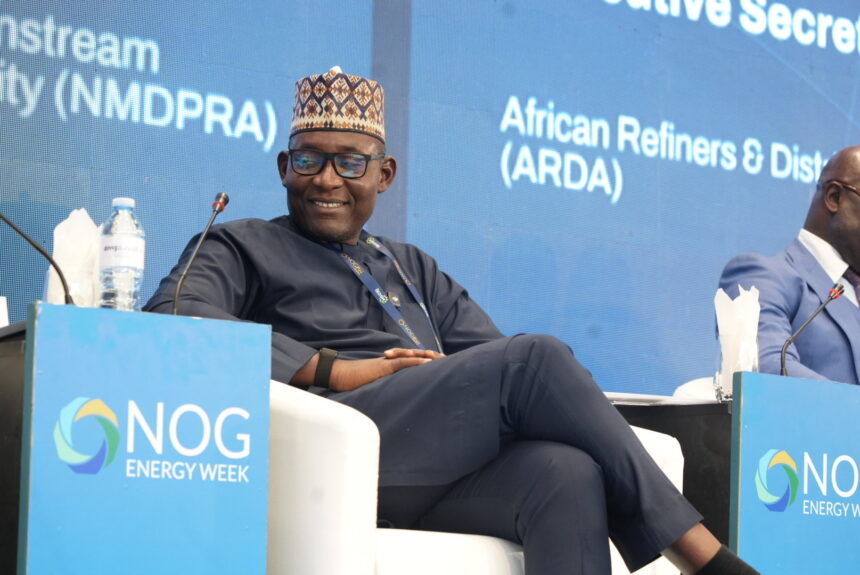
He made this known on Wednesday while speaking during a panel session titled “Scaling Downstream Capacity – Optimising Africa’s Oil Value” at the just-concluded NOG Energy Week 2026 in Abuja.
The NMDPRA’s boss emphasized that the oil and gas industry experienced three major seismic shifts in the last 5 years including the petroleum products price deregulation, the Petroleum Industry Act (PIA) 2021, and a shift from being an import dependent industry to being a net exporter of petroleum products with the operationalization of the Dangote Petroleum Refinery and Petrochemicals Company Limited.
The ACE said, “The PIA is very clear about the concept of a National Strategic Reserve. Globally, this aligns with the International Energy Agency (IEA) model, where countries maintain emergency oil stocks sufficient to cover at least 90 days of net imports and are prepared for coordinated releases during severe supply disruptions.”

While the 90-day reserve benchmark is important, Umar noted that the country’s priority is increasingly shifting towards building resilience in line with our growing domestic refining capacity.
According to him, resilience, in this context, means ensuring that petroleum products are available where they are needed across the country at all times.
He said, “Nigeria spans nearly one million square kilometres, yet a significant portion of our storage infrastructure and tank farms remains concentrated along the coast regions.
“This concentration creates systemic vulnerabilities, especially in the event of disruptions.
“Although we have about thousands of kilometres of petroleum products pipeline network (some of which are not in optimal condition).
“We also have several storage facilities that are still in very good shape and can be optimally utilised.
“We are therefore working with relevant agencies to develop a clear and comprehensive framework that will enable the strategic placement of products across the country, ensuring flexibility and supply security.
“The recent concerns around a potential Strait of Hormuz closure serve as a stark reminder that the world is always one energy shock away from a major crisis.
“It is not a question of if such a disruption will occur, but when. Our objective is to ensure that, whenever it happens, Nigeria has sufficient buffers positioned in strategic locations to maintain stability and continuity of supply,” he said.
Speaking on the need to boost gas infrastructure to drive industrialisation and manufacturing across the country, Umar identified the Ajaokuta–Kaduna–Kano (AKK) pipeline as a strategic shift that will enable Nigeria to domesticate production capabilities by bringing gas supply closer to end-user markets in other regions.
He said, “Even from an infrastructure perspective, if you look at the gas space today, the AKK pipeline represents a strategic shift.
“Currently, a significant share of our manufacturing activities and power generation is concentrated in the southern part of the country, particularly south of the Niger.
“By expanding gas infrastructure to other regions, we can ensure that supply reaches multiple locations, enabling production capabilities to be more domesticated and situated closer to end-user markets.
“This approach not only supports industrial growth across the country but also strengthens resilience, ensuring that a disruption in one region does not impact the entire nation,” the ACE said.
The NMDPRA’s boss therefore emphasised that his focus is on building a more flexible and resilient energy supply system by decentralising infrastructure and reducing overdependence on any single location, ensuring that disruptions in one area do not translate into nationwide supply challenges.
He explained that the anticipated outcome of the reforms will help Nigeria achieve its strategic pursuit of transitioning to cleaner energy and a boost in power generation to meet our national energy needs.