


… revives petrol import legal battle despite missing 50ml/day consumption benchmark for four straight months
Oredola Adeola
Nine months after discontinuing its earlier legal action, Dangote Petroleum Refinery has instituted a fresh lawsuit against Lateef Olasunkanmi Fagbemi and the Nigerian Midstream and Downstream Petroleum Regulatory Authority (NMDPRA), challenging the issuance of new petrol import licences to six oil marketing companies.
The suit, filed before the Federal High Court, seeks to void recently approved licences for the importation of a combined 180,000 metric tonnes of Premium Motor Spirit (PMS), commonly known as petrol, which the refinery argues contravenes Sections 317(8) and 317(9) of the Petroleum Industry Act (PIA).
According to court documents seen by Reuters, the latest filing effectively revives a previous legal dispute that the refinery had earlier withdrawn concerning similar import approvals.
Advisors Reports gathered that the latest deveopment comes months after Dangote Refinery withdrew its ₦100 billion lawsuit against the NMDPRA, Nigerian National Petroleum Company(NNPC) Limited, as well as AYM Shafa Limited, A.A. Rano Limited, T.Time Petroleum Limited, 2015 Petroleum Limited, and Matrix Petroleum Services Limited.
Recall that notice of discontinuance, dated July 28, 2025, was filed by the refinery’s legal counsel led by Ogwu Onoja, SAN, with the matter formally struck out by the court on July 29, 2025.
Meanwhile, Dangote Refinery in the fresh lawsuit, reportedly argued that the new import permits issued or renewed by the NMDPRA breached an earlier court order directing parties to maintain the status quo pending determination of the substantive matter.
The refinery reportedly maintained that the continued approval of petrol imports undermines its operations and contradicts provisions of the PIA, which prioritises local refining and permits imports only in cases where domestic supply is insufficient to meet national demand.
NMDPRA under the leadership of Acting Authority Chief Executive Abiodun Adeniji, had defended the approval of licences for the importation of a combined 180,000 metric tonnes of petrol by the six oil marketing companies, attributing the decision to supply disruptions and shortages caused by global market shocks stemming from the ongoing Middle East conflict.
The Authority stated that while Nigeria continues to prioritise domestic refining under the PIA framework, importation remains necessary whenever local production fails to satisfy consumption requirements
Industry data released by the NMDPRA and reviewed by Advisors Reports showed that the 650,000 barrels-per-day Dangote Refinery achieved full operational utilisation in April 2026, producing about 53.6 million litres of petrol daily during the month.
However, despite operating at 100 per cent refining capacity, the facility supplied only 40.7 million litres per day to the domestic market while exporting approximately 17.1 million litres daily.
The refinery reportedly supplemented exports using part of its existing stock position of 10.6 million litres per day carried over as of March 31, 2026.
The data further showed that Nigeria’s average daily petrol consumption stood at 51.1 million litres in April, leaving a supply gap of about 9.4 million litres per day that had to be covered through alternative sources including importation.
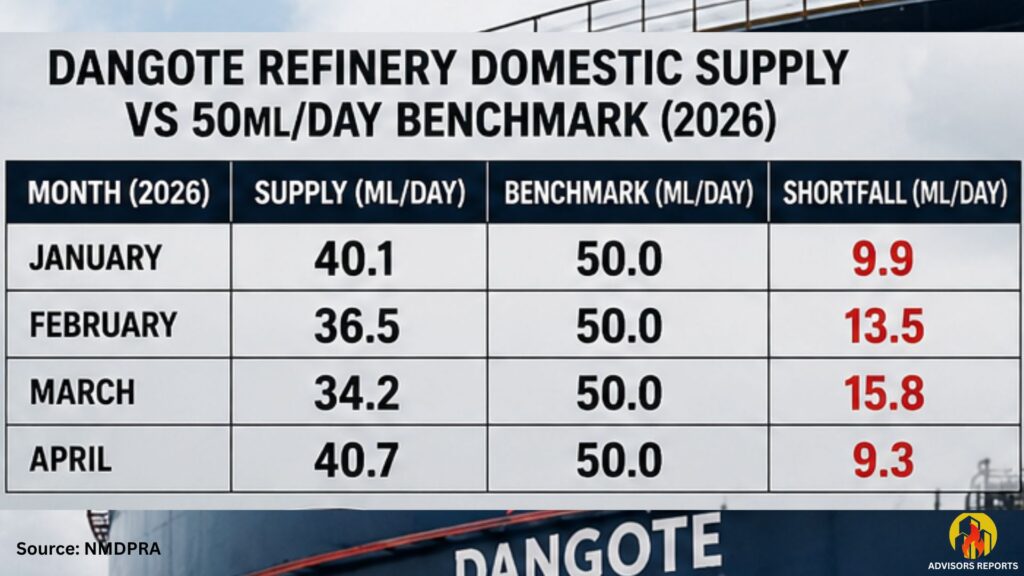
The Authority’s factsheet for January, February, March and April 2026 analysed by Advisors Reports also showed that the refinery has consistently fallen short of the country’s estimated daily consumption benchmark since the beginning of the year.
In January 2026, the refinery supplied 40.1 million litres per day to the domestic market, followed by 36.5 million litres per day in February, 34.2 million litres per day in March, and 40.7 million litres per day in April.
None of the monthly supply volumes met the estimated national consumption benchmark of 50 million litres per day for 2026.
Efforts by Advisors Reports to verify this position with the Authority and the Office of the AGF were unsuccessful, as both parties had not responded to requests for comments at the time of filing this report.