

… producers lean toward premium‑priced exports amid weak enforcement of DCS rules
Oredola Adeola
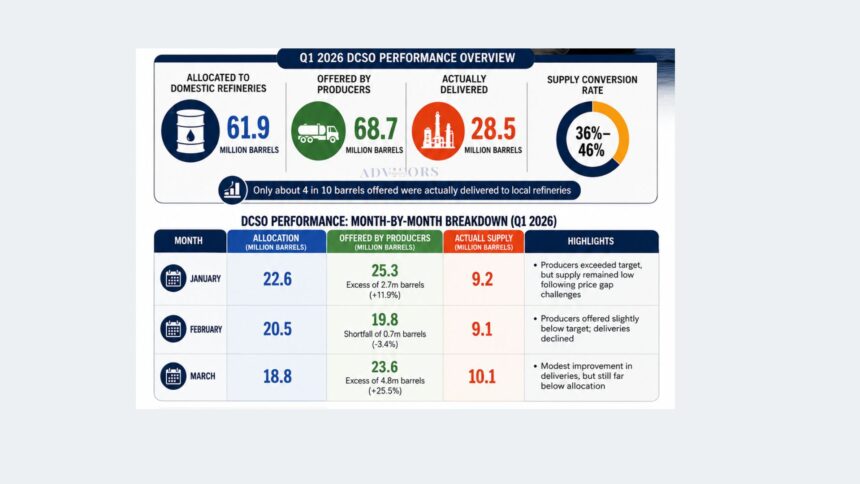
Actual crude deliveries to Dangote and other domestic refineries plunged to just 28.5 million barrels in Q1 2026, despite 61.9 million barrels allocated and 68.7 million barrels offered under the Domestic Crude Supply Obligation (DCSO), with the Nigerian Upstream Petroleum Regulatory Commission (NUPRC) blaming the shortfall largely on pricing gaps between producers and local refiners.
NUPRC disclosed this in its latest statistics on the enforcement of the DCSO, issued in accordance with the provisions of the Petroleum Industry Act (PIA) in a statement released by Eniola Akinkuotu, Head of Media and Corporate Communication, and obtained by Advisors Reports.
A breakdown of the figures showed that actual supply lagged at 28.5 million barrels, translating to a conversion rate of about 36–46 per cent by the end of Q1 2026.
Month-on-month data reveal that in January, the Commission mandated the supply of 22.6 million barrels following consultations with stakeholders, with producers exceeding the target by offering 25.3 million barrels—an increase of 11.9 per cent—though only 9.2 million barrels were eventually delivered.
In February, allocations stood at 20.5 million barrels, while producers offered slightly lower volumes of 19.8 million barrels, missing the target by 700,000 barrels, with actual supply declining to 9.1 million barrels.
By March, deliveries improved modestly to 10.1 million barrels, compared to 9.2 million barrels in January and 9.1 million barrels in February, even as allocations were set at 18.8 million barrels and producers offered a significantly higher 23.6 million barrels, exceeding the requirement by 4.8 million barrels, or 25.5 per cent.
The NUPRC, in the statement, emphasised that the current framework operates on a “willing buyer, willing seller” basis, a structure that continues to significantly influence transaction outcomes under the DCSO arrangement.
Despite the supply gaps recorded during the quarter, the Commission reaffirmed its commitment to achieving the Federal Government’s broader objective of energy sufficiency.
It further noted that, leveraging the provisions of the Petroleum Industry Act (PIA) 2021, it will sustain recent gains in crude oil production while continuously refining the DCSO implementation framework to improve transparency, efficiency, and ensure consistent supply of crude oil to domestic refineries in line with established commitments.
Advisors Reports figure reported by NUPRC for Q1 2026 align with earlier market analyses that have long flagged the DCSO as a well‑intended but under‑delivered mechanism.
The Q1,2026 statistics showed persistent price gaps, disputes over FX terms, and weak enforcement levers often leave domestic refiners receiving far less crude than what is formally allocated or offered.
The Q1 2026 shortfall reflects these structural pressures, reinforcing concerns that the “willing buyer, willing seller” structure of the DCSO, while consistent with the Petroleum Industry Act’s commercial tenor, still leaves room for producers to favour higher‑priced export outlets over local refineries, especially when NUPRC’s sanctions and enforcement tools remain limited in practice.