Advisors ReportsAdvisors Reports
  • News
  • Editorial
  • Feature
  • Special Report
  • Oil & Gas
    • Upstream
    • Midstream
    • Downstream
  • Power
    • Generation
    • Distribution
    • Transmission
  • Renewables
    • Solar
    • Nuclear
    • Hydrogen
  • Extractive Industry
  • Maritime
Search

Archives

  • February 2026
  • January 2026
  • December 2025
  • November 2025
  • October 2025
  • September 2025
  • August 2025
  • July 2025
  • June 2025
  • May 2025
  • April 2025
  • March 2025
  • January 2025
  • December 2024
  • November 2024
  • October 2024
  • September 2024
  • August 2024
  • July 2024
  • June 2024
  • May 2024
  • April 2024
  • March 2024
  • February 2024

Categories

  • Advertorial
  • Concession
  • Distribution
  • Documentary
  • Downstream
  • Editorial
  • Energy Transition
  • Environment
  • Extractive Industry
  • Feature
  • Finance
  • Gas
  • Generation
  • Green Finance
  • Hospitality
  • Hydrogen
  • Hydroplant
  • Impact
  • Interview
  • Local Content
  • Maritime
  • Midstream
  • Mining
  • Mining & Solid Mineral
  • Multilateral Finance
  • News
  • Nuclear
  • Oil
  • Oil & Gas
  • Oil theft
  • Opinion-editorial
  • Photo News
  • Power
  • Renewables
  • Review
  • Sabotage
  • Security
  • Service Company
  • Solar
  • Special Project
  • Special Report
  • Sustainability
  • Technology
  • Transmission
  • Upstream
© 2022 Foxiz News Network. Ruby Design Company. All Rights Reserved.
Reading: System Operator begins load shedding amid gas shortages, power generation drops below 4,500 MW
Share
Sign In
Notification Show More
Font ResizerAa
Advisors ReportsAdvisors Reports
Font ResizerAa
Search
Have an existing account? Sign In
Follow US
© 2022 Foxiz News Network. Ruby Design Company. All Rights Reserved.
DistributionGenerationNewsPowerTransmission

System Operator begins load shedding amid gas shortages, power generation drops below 4,500 MW

admin
admin
Share
3 Min Read
SHARE

… power plants receive 692 MMSCF of gas, 937 MMSCF short of daily requirement

… as grid relies heavily on Egbin, Azura-Edo

Oredola Adeola

The Nigerian Independent System Operator (NISO) has announced load shedding nationwide as power generation drops to an average of 4,300 MW, far below the country’s installed capacity of 13,000 MW, majorly due to insufficient gas supply to thermal power plants.

NISO made this known in a document released on Friday to the market players in response to the latest development.

According to the System Operator, thermal plants account for the dominant share of Nigeria’s generation mix, and any disruption in gas supply directly affects generation capacity and overall grid output.

It said, “Consequently, the current energy allocated to Distribution Companies (DisCos) reflects the reduced supply available on the grid.

NISO further explained that thermal power plants collectively require 1,629.75 million standard cubic feet (MMSCF) of gas per day to operate at optimal capacity.

However, as of February 23, 2026, actual gas supply to the stations stood at approximately 692 MMSCF, representing less than 43% of the required volume, resulting in constrained generation output.

NISO explained that when total system generation drops significantly, it must implement load shedding, dispatching available energy in line with NERC MYTO allocation percentages across all distribution networks to maintain grid stability and prevent system disturbances.

The system operator appealed to Nigerians for the inconvenience caused to electricity consumers and market participants, assuring that it will continue working closely with relevant stakeholders to restore full energy allocation as soon as gas supply improves and generation capacity is restored.

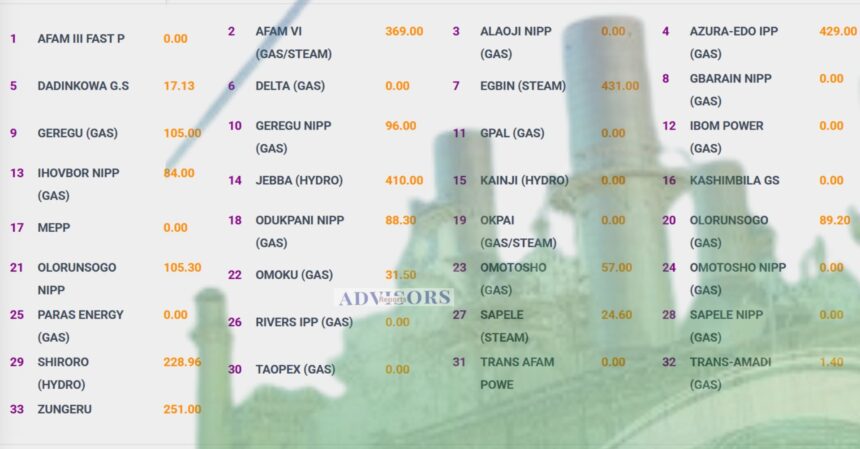
Checks by Advisors Reports showed that Nigeria’s electricity grid averaged 4,123 MW between February 20 and 26, 2026, with daily outputs ranging from 3,569 MW to 4,534 MW from 17–18 active power plants.

This remains significantly below the country’s installed capacity of around 13,000 MW.

Energy experts and market stakeholders have continued to warn that the underperformance of several NIPPs and IPPs, combined with heavy reliance on a few high-capacity plants such as Egbin and Azura-Edo, could pose risks to a consistent electricity supply for industrial, commercial, and residential consumers.


Sign Up For Daily Newsletter

Be keep up! Get the latest breaking news delivered straight to your inbox.
[mc4wp_form]
By signing up, you agree to our Terms of Use and acknowledge the data practices in our Privacy Policy. You may unsubscribe at any time.
Share This Article
Facebook Copy Link Print
Share
Previous Article Seplat Energy reports 148% rise in production, revenue hits $2.73bn in first offshore consolidation year
Next Article NMDPRA commissions integrated CNG conversion, refuelling station at OAU
Leave a Comment Leave a Comment

Leave a Reply Cancel reply

You must be logged in to post a comment.

Recent Posts

  • NMDPRA commissions integrated CNG conversion, refuelling station at OAU
  • System Operator begins load shedding amid gas shortages, power generation drops below 4,500 MW
  • Seplat Energy reports 148% rise in production, revenue hits $2.73bn in first offshore consolidation year
  • NMDPRA-backed Dangote distribution framework draws mixed industry reactions
  • Aradel Holdings achieves ISO 45001:2018 certification, strengthening workplace safety, employee wellbeing

Recent Comments

No comments to show.
Follow US
© 2022 AdvisorsReports. All Rights Reserved.
Welcome Back!

Sign in to your account

Username or Email Address
Password

Lost your password?