

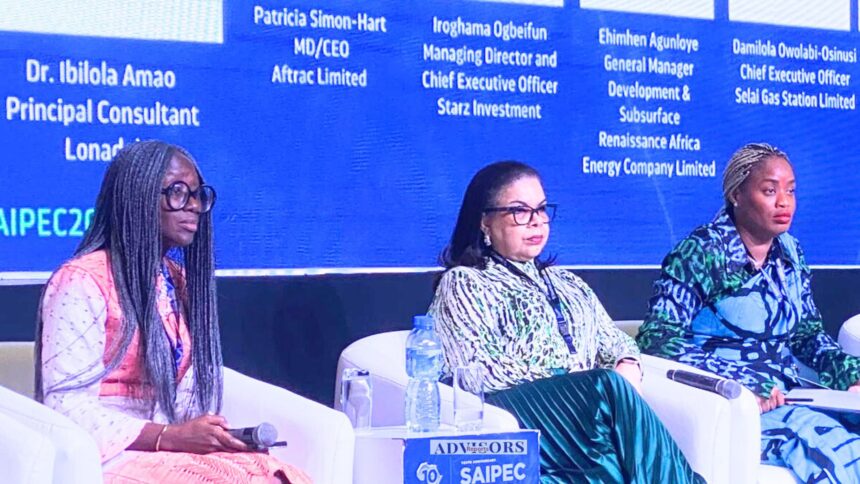
“Regardless of where we sit in leadership position… start by tracking and managing women data” -CEO Aftrac Ltd.
Oredola Adeola
Patricia Simon-Hart, MD/CEO of Aftrac Limited, urged women in leadership across energy companies and government agencies to take deliberate steps toward gender inclusivity by tracking and managing women data within their organizations.

She made these remarks during a panel session, the Next Generation Fireside Chat: Leading Africa’s Oil and Gas Future – Voices, Challenges and Impact, held on the sidelines of the just concluded Sub-Saharan Africa International Petroleum Exhibition and Conference (SAIPEC) 2026 in Lagos.
Emphasizing the importance of using women data as a baseline for measuring progress, she said, “As a sector, we need to collect and analyze the data to understand how many women can start in these roles.”
“This baseline allows us to monitor progress and ensure we are actively building their representation over time.
“Regardless of where we sit in leadership position—whether on the board or in management—let us take the initiative to start by tracking and managing women data within your organizations,” she urged fellow women in energy.
Simon-Hart further explained that the board and management of Aftract Ltd. had set a target of 40% female representation in management to strengthen gender inclusivity.
She said, “And because of that, the board set a target, a very ambitious target for our management, which is 40%. But we know it wasn’t so high. We are still striving to achieve that, and at the last review we had, we saw the need to push for more women.
“When you see the data, it’s one of the jokes everybody says, ‘Oh, well, only 15%, only 10%, only 20% of women in the company.’
“And then you suddenly wake up to reality and know that our targets are too low, the number of women working in the organization is too low. So that’s very, very important,” she added.
On how to sustain progress, she said, “Creating more opportunities for women to be trained and exposed within the sector is important.
“Building the pipeline is critical. We need to catch women young, at universities, and make them aware that there are technical and engineering roles beyond field or administrative jobs.
“Associations like WIEN are doing a lot to ensure we expand the pipeline and bring more women into the sector,” Simon-Hart said.
Acknowledging the historical challenges of oil and gas industry field operations for women, she said, “Getting women in the field has always been a challenge. I know I’ve always recruited female engineers, trying to get them onto the field, especially offshore—it used to be impossible.
“It was always a battle—trying to get women into certain roles, especially in challenging field locations. On land assignments, I made sure to be considerate, but over time, women could transition to back end or less physically demanding roles,” she said.
According to her, women have a vital role alongside men in the sector, particularly in emerging areas of technology.
She said, “With the new emerging technologies, a lot of data, AI, generated AI, there are other areas opening up where women can actually begin to build capacities in and around, so that they’re also very relevant in the sector. So, it’s not just the hard end.”
MD/CEO of Aftract Limited recognized that while some manual fieldwork may be unsuitable for women, there are specialized and technical roles they can excel in
“I once worked in surface well testing, and I know there are certain physically demanding tasks—like handling pipes or assembling heavy equipment—that women are rarely involved in.
“However, there are many specialized and technical roles where women can excel, and I believe we should continue building the capacity pipeline to support them in those areas,” she said.
Simon-Hart has therefore stated that tracking women data is a practical, actionable first step toward gender inclusivity, building talent pipelines, and strengthening the sector’s workforce.