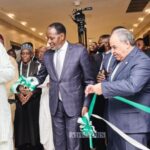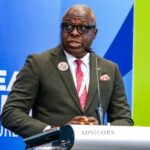

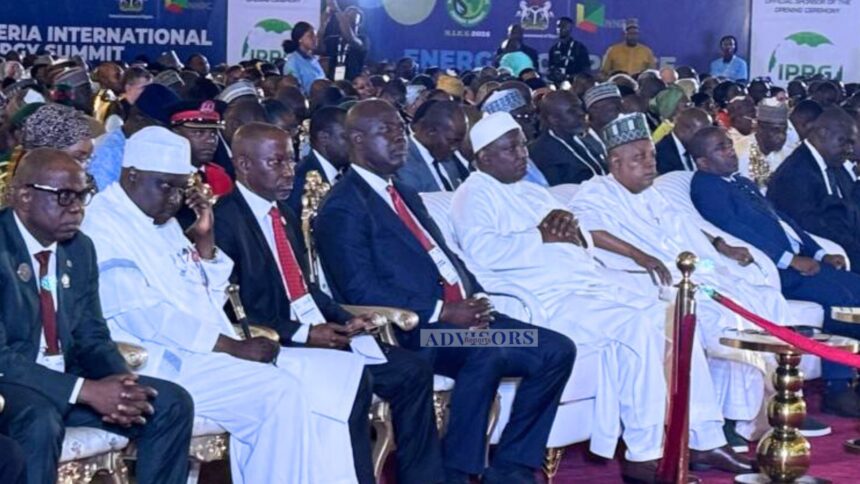
… hosts African leaders at #NIES2026 in Abuja
President Barrow says Nigeria’s oil, gas leadership influence extends beyond its borders
Nigeria’s prosperity directly impacts Equatorial Guinea, Africa’s growth – President Obiang

Oredola Adeola
President Bola Tinubu has reaffirmed Nigeria’s commitment to collaborating with global partners, African nations, investors, and development institutions to deliver energy that is affordable, secure, and cleaner, while also scaling up infrastructure and expanding access across the country.
President Bola Tinubu on Tuesday hosted African heads of state and captains of industry at the high-level Nigeria International Energy Summit (NIES) 2026 in Abuja.
The summit, aimed at deepening continental cooperation on energy security, investment, and industrial growth, is ongoing with the theme: “Energy for Peace and Prosperity: Securing Our Shared Future.”
Represented at the summit by Vice President Kashim Shettima, President Tinubu emphasized that Nigeria is ready to work with global partners, African nations, investors, and development institutions to deliver energy that is affordable, secure, and cleaner, while scaling up infrastructure and investment for expanded access.
Describing energy as “the invisible force that holds the world together” and “a vital architecture of balance among nations,” Tinubu stated:
“Energy is a fulcrum of stability. That is why we cannot afford complacency in how we use it. We must constantly reinvent and improve how we manage our energy needs.”
He further highlighted Nigeria’s pivotal role:
“From within Nigeria, we are positioned to meet the energy needs of the world. We need energy to keep the world alive. Crude oil and gas remain among our finest natural resources, and energy is central to peace and prosperity. It is a national priority and a cornerstone for sustainable development and global engagement.”
President Tinubu reaffirmed Nigeria’s strategic relevance in the global energy landscape and called on the international community, service providers, and development partners focused on sustainable energy to leverage their platforms for dialogue to promote a balanced and diverse energy mix.
President Adama Barrow urged African nations to prioritize reliable and sustainable energy systems, describing energy as the foundation of national security and economic growth. He noted that millions across the continent still lack electricity, limiting healthcare delivery and undermining Africa’s global competitiveness.
“Energy transitions that are poorly managed can lead to social crises,” Barrow warned, emphasizing that affordable and diversified energy is both an economic necessity and a moral imperative.
He specifically praised Nigeria’s leadership, highlighting that Africa’s largest and most energy-endowed nation has a central responsibility to advance shared continental goals and ensure energy supports prosperity for all.
The Gambia, he said, is committed to energy diversification and affordability, transforming energy from a national resource into a tool for continental growth.
President Teodoro Obiang Nguema Mbasogo, represented by Domingo Mba Esono Nzang, Deputy Minister of Mines and Hydrocarbons for Equatorial Guinea, emphasized that energy is not merely an economic commodity but a tool of sovereignty and a driver of economic growth.
He highlighted Equatorial Guinea’s commitment to regional cooperation, noting that Nigeria’s prosperity directly impacts the prosperity of other African nations.
President Obiang pointed to the Gulf of Guinea pipeline as part of Equatorial Guinea’s strategic plan to process gas and position itself as a gas hub for West Africa.
He stressed that Africa cannot accept the abandonment of its natural resources while millions remain without access to energy, calling gas a vital resource for the continent’s development.
He expressed support for the Equatorial Guinea 2023 Licensing Round, describing it as an ambitious initiative with both onshore and offshore opportunities.
With proven political stability, he urged international partners to collaborate in developing the country’s energy sector.
President Obiang further argued that Africa must move beyond exporting raw materials, transforming resources into long-term prosperity for future generations.