

… as petrol pump prices climb to ₦1,200/L in Lagos, edge toward ₦1,500/L
Oredola Adeola
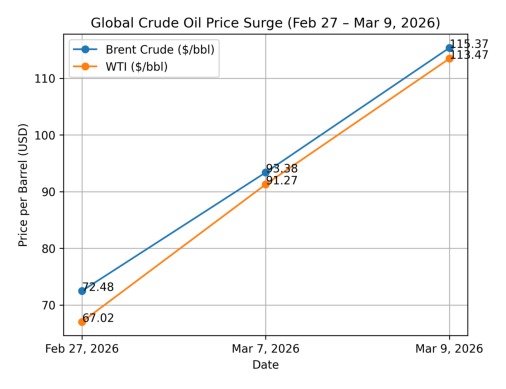
Global crude oil prices have surged dramatically, with Brent Crude rising above $115.37 per barrel as of Monday, March 9, 2026, up from $93.38/bbl recorded on Friday, March 7—representing a sharp increase of about 23.6 percent within a few days.
Similarly, West Texas Intermediate (WTI) climbed from $91.27/bbl to $113.47 per barrel, marking a surge of roughly 24.3 percent over the same period.

The rally in global crude prices follows the escalating conflict involving Iran, the United States and Israel, which has now entered its tenth (10) day since the initial U.S. and Israeli airstrikes that began around February 28 (IRST).
The rapidly expanding confrontation has heightened fears of major supply disruptions in the Middle East, a region responsible for a significant share of global oil exports.
Advisors Reports recalls that the last time crude prices crossed the $100 per barrel threshold was in 2022, when Brent rose to about $104/bbl amid strong post-pandemic demand and the geopolitical shock triggered by the Russian invasion of Ukraine.
However, the March 2026 surge appears more complex, as it is being driven not only by geopolitical tensions but also by direct attacks on energy infrastructure and threats to strategic oil transit routes.
Market participants say the possibility of disruptions to crude shipments through the Strait of Hormuz, one of the world’s most critical oil corridors, is now being heavily priced into the global market.
They warned that the prolonged supply disruptions in the Middle East, combined with attacks on energy facilities, could tighten global crude supply and sustain the current price rally.
The conflict escalated further after the Israel Defense Forces reportedly carried out the first direct strikes on Iran’s energy infrastructure since the war began, targeting oil storage complexes and a fuel transfer facility near Tehran.
Iranian state media reported four fatalities, including tanker drivers, while also confirming temporary disruptions to local fuel distribution following the attacks.
The surge in global crude oil prices has already begun to reverberate across Nigeria’s domestic fuel market.
Checks by Advisors Reports indicate that petrol pump prices in several parts of Lagos are now edging towards ₦1,500 per litre, as a number of filling stations remained shut on Sunday while others dispensed fuel at between ₦1,000 and ₦1,200 per litre, depending on location and outlet.
Market analysts warn that the continued surge in pump prices could trigger wider economic implications, particularly through rising inflationary pressures and increased transportation costs, which are likely to cascade across food distribution, logistics, and other key sectors of the economy.
Some independent filling stations reportedly suspended operations temporarily amid rising market volatility and uncertainty in supply pricing.
Market sources also linked the development to the decision by the Dangote Refinery to suspend petrol loading at its gantry, which has slowed inland truck-out distribution.
Industry insiders disclosed that the refinery has prioritised coastal loading, as it strengthens a restructured offtake arrangement with selected members of the Depot and Petroleum Products Marketers Association of Nigeria and the Major Energies Marketers Association of Nigeria.
These marketers control a significant number of coastal petroleum depots in Lagos and other coastal parts of Nigeria, making marine distribution a strategic route for product evacuation from the refinery.
The latest surge in crude prices is expected to boost revenues for the Nigerian National Petroleum Company Limited and strengthen Nigeria’s fiscal outlook, given that the 2026 federal budget benchmark oil price was set at $64.85 per barrel, far below current market levels.
However, analysts warn that higher global crude prices could also worsen domestic inflationary pressures, particularly through rising fuel costs and transport expenses.
Meanwhile, **Brent Crude remains the key international benchmark used in pricing Nigeria’s crude oil grades, which typically trade at a premium of between $3 and $6 per barrel above Brent, depending on quality and market conditions.
The Dangote Refinery has previously maintained that its operations have helped stabilise Nigeria’s fuel supply, helping to prevent acute petrol shortages and even sharper pump price increases despite rising crude prices in the international market.
Energy analysts say the coming days will determine whether continued geopolitical escalation and supply disruptions will push crude prices even higher or trigger emergency supply responses from major oil-producing countries.