

… NLNG, Dangote, others maintain year-long dominance throughout 2025 as imports remain marginal
… consumption climbs to 5,050 MT/d in Jan. 2026 as prices drop to N950–N1,550 per kg
Oredola Adeola
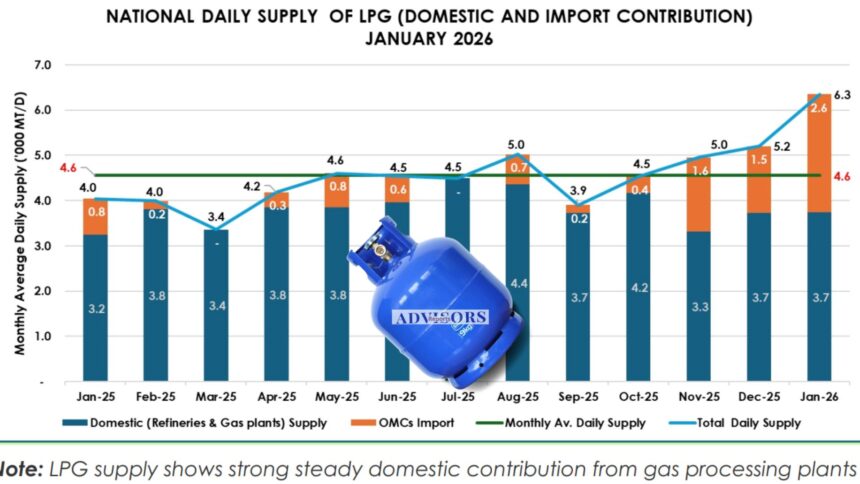
Domestic gas producers, led by NLNG, Dangote, and others, delivered an average of 3,700 metric tonnes per day in January 2026, surpassing imports, which stood at 2,600MT/day, out of a total 6,300 MT/day supplied during the month.

This translates to domestic producers contributing approximately 59 percent of total gas supply, against imports at 41%, as local production continues to meet Nigeria’s cooking gas needs.
This was revealed by the Nigerian Midstream and Downstream Petroleum Regulatory Authority (NMDPRA) in its State of the Downstream Sector Fact Sheet for January 2026, obtained by Advisors Reports over the weekend.
On a year-on-year basis, the data showed that local producers supplied an average of 3,700 metric tonnes per day in January 2026, up from 3,200 MT/day in January 2025.
Meanwhile, imported volumes also increased, averaging 2,600 MT/day in January 2026, compared with 800 MT/day in the same month of 2025.
On a month-to-month basis, domestic suppliers maintained a stable supply of 3,700 MT/day between December 2025 and January 2026, while import volumes increased to 2,600 MT/day in January 2026, up from 1,500 MT/day in December 2025.
An average of 4,860 MT/day of cooking gas was trucked out into the domestic market in January 2026.
Average daily cooking gas consumption rose to 5,050 MT/day in January 2026, as prices fell to between N950 and N1,550 per cylinder, down from December 2025 when retail prices ranged from N1,120 to N1,600 per kilogram and consumption averaged 4,380 MT/day.
The highlight of the factsheet for January 2026 established that for over thirteen (13) months, emphatically throughout 2025, supply of cooking gas by Nigerian producers consistently accounted for the majority of the country needs.
In key months like February, March, and July, local production met nearly 100% of total demand, with imports either negligible or completely absent.
Monthly figures reveal that domestic supply ranged from 3.2k MT/day in January to a peak of 4.5k MT/day in July.
Imports remained low throughout the year, even during higher import months like November (3.3k MT/day domestic, 1.6k MT/day imports) and December (3.7k MT/day domestic, 1.5k MT/day imports), local production consistently supplied the majority.