

Precious Ademisoye
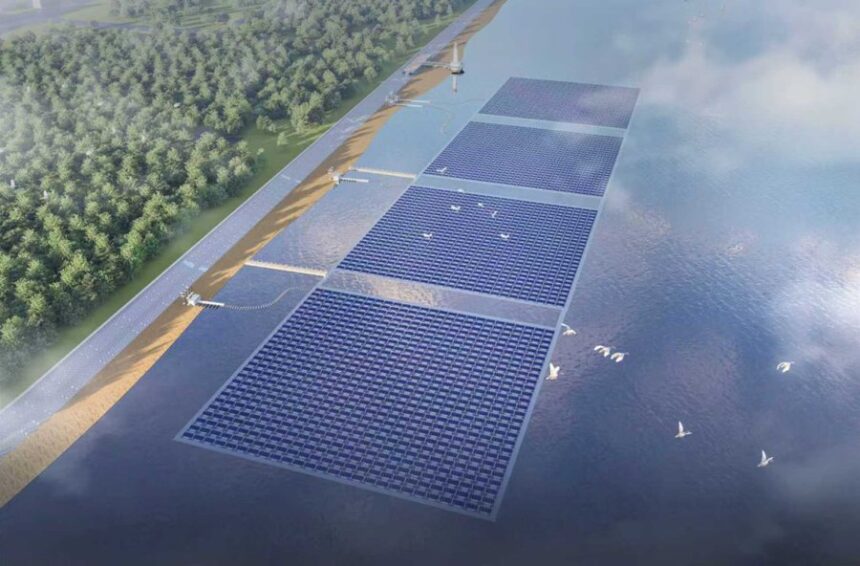
The Nigerian subsidiary of China Civil Engineering Construction Corporation (CCECC) has emerged as the preferred bidder for the 7-megawatt floating solar power project at the University of Lagos, a development described as Nigeria’s first floating solar power station.
The confirmation was contained in a statement by Mr. John Zhao, Director at CCECC Nigeria Limited, obtained by Advisors Reports on Wednesday.

The project is to be sited on the lagoon waters surrounding the university campus.
According to the Chinese state-owned construction firm, the facility, when completed, will supply the University of Lagos with safe, stable and clean electricity, while marking a major milestone in Nigeria’s renewable energy development as the country’s first floating solar power installation.
Earlier in 2025, Mr. Abba Aliyu, Managing Director of the Rural Electrification Agency (REA), had hinted at the floating solar project during the Lagos Energy Summit, disclosing that it forms part of a broader collaboration between the REA and partners aimed at scaling up renewable energy access for unserved and underserved communities.
Aliyu explained that the initiative is being implemented under the Distributed Access through Renewable Energy Scale-up (DARES) programme, following the signing of a Memorandum of Understanding (MoU).
While details of the contract and project timeline have not been made public, Advisors Reports gathered that, upon completion, the facility is expected to provide the University of Lagos with a continuous supply of sustainable, green and reliable power, significantly improving energy use on campus and addressing its long-standing electricity challenges.
The development is particularly significant given the university’s recent power supply difficulties.
In August 2024, the Eko Electricity Distribution Company (EKEDC) disconnected the University of Lagos from the national grid over unpaid electricity bills estimated at more than ₦1 billion, despite a ₦180 million payment that covered only part of the outstanding arrears.
Although the dispute was subsequently resolved by both parties, the floating solar power project is expected to provide significant relief to the institution’s energy burden.
Advisors Reports gathered that the university is estimated to spend an average of about $820,000 monthly on diesel to power generators, in addition to approximately $228,500 on electricity supplied from the grid by EKEDC.