
…says Africa’s emissions will remain below 3% even if all its hydrocarbon resources are explored
Oredola Adeola
Senator Heineken Lokpobiri, Minister of State for Petroleum Resources (Oil), has said that with a population of about 1.5 billion people and daily imports exceeding 120 million litres of petroleum products, Africa presents a ready-made market that Nigeria must strategically harness.
He therefore warned that halting hydrocarbon development would be disastrous for Africa

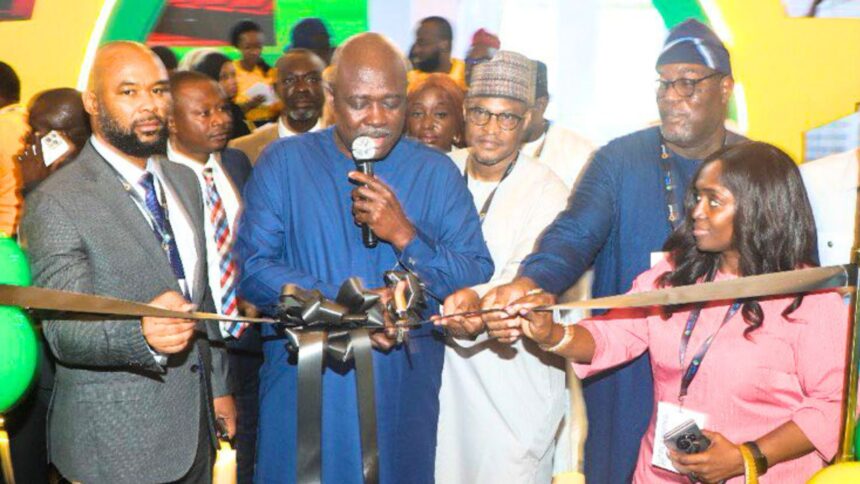
The Minister, who represented President Bola Tinubu at the 19th OTL Africa Downstream Energy Week in Lagos on Monday, stated this during his presentation at the opening session of the week-long conference.
According to him, “By 2024, data showed that African countries collectively invested about $120 billion worth of hydrocarbon resources. Yet, there is no corresponding market for it.
“This means we are not getting the full value we should, because we have limited refining capacity and weak distribution networks.
“Most of the money goes back to countries outside Africa that invested in these resources.”
“The target of the Nigerian government is to see how we can retain a large proportion of this capital within our borders.
“That is why Nigeria is planning to launch the West African Petroleum Market.
“The idea is to make Nigeria the refinery and distribution hub for the entire continent.”
“The entire continent is waiting for Nigeria to take the lead as a major supplier and distributor of petroleum products.
Recall that every volume of petroleum product imported into Nigeria eventually finds its way across the West African regional market,” he explained.
The Minister further emphasised that the International Energy Agency (IEA), which for years has been one of the strongest proponents of the net-zero vision — a campaign that has threatened the value of oil and gas globally — has now acknowledged the need for sustained upstream investment.
He said, “The 2025 IEA report clearly shows that the world needs to invest about $540 billion annually in upstream oil and gas development to avoid a global energy crisis by 2050.”
“So, those who have been promoting the net-zero narrative are now realizing that without adequate oil and gas investment, the world will face an energy crisis.
“Oil and gas currently account for over 50 percent of global energy demand, and by 2050, the world’s GDP will still depend heavily on hydrocarbons,” he said.
Sen. Lokpobiri stated that based on that new global narrative, if Africa combines investments across the entire value chain — upstream, midstream, and downstream — the world will need to invest over $700 billion annually to avoid an energy crisis by 2050.
He said, “That’s good news for Nigeria.
“The discussion has always been about energy transition, but we must understand why we are transitioning and how to fund it.
“While sustaining investment in oil and gas, we must also expand those investments and use the proceeds to finance renewable energy.
“Even if we want renewables, we still need oil and gas money to fund them.”
Speaking on the significance of Nigeria’s plan to become Africa’s refinery hub, the Minister stated that the ongoing expansion of the Dangote Refinery to 1.4 million barrels per day aligns with efforts to meet the energy needs of West Africa and the broader continent.
He said, “The Federal Government will fully support Dangote to achieve this. That is one of the reasons petrol subsidy was removed. With subsidy in place, the private sector cannot grow.”
“The downstream and midstream sectors will only grow when the private sector can mobilize capital and invest locally.
“Deregulation and privatization paved the way for availability, accessibility, and affordability.
“No matter the challenges, if we don’t embrace these reforms, Nigeria’s economy could crumble.”
“Before now, the government was spending over ₦2 trillion annually on fuel subsidies.
“Those funds are now being redirected to more productive uses.
“The truth is, the subsidy regime ended up subsidizing consumption across the West African subregion, not just Nigeria,” he noted.
Sen. Lokpobiri further urged stakeholders at the conference to understand that the world’s energy dynamics are changing.
According to him, energy security is not just about drilling barrels; it’s about creating a sustainable ecosystem across the value chain.
He said, “Africa has crude oil reserves of about 140 billion barrels and natural gas reserves exceeding 600 trillion cubic feet.
“Even if we explore all our hydrocarbon resources, the entire continent will still be contributing less than 3 percent to global emissions.”
“Global warming will not stop even if Africa shuts down its 3 percent contribution, while those responsible for 97 percent are not slowing down on emissions.
That is why it will be disastrous for Africa to abandon its hydrocarbon development.”
“When Nigeria speaks, we must speak boldly and insist on our own narrative.
“We must have a common agenda and a united African voice against the unrealistic promoters of net zero.”
“The downstream sector cannot succeed without a strong upstream and midstream foundation. There are opportunities for everyone with the requisite capital and expertise.”
“Over the past two years, we have seen renewed investor interest in Nigeria’s oil and gas industry.
“There is capital in the United States and other parts of the world, and Africa itself is estimated to hold over $4 trillion in investable funds.
“The challenge is that we have not been able to access this capital.”
enator Lokpobiri further cautioned that Africa must resist allowing Western narratives to “weaponize capital” against the continent, urging governments to develop homegrown solutions for energy financing across the upstream, midstream, and downstream sectors.
He stressed, “Even if the West decides not to invest in our hydrocarbons, Africa must continue to invest in its energy future.”
According to him, “There is no truth in the so-called billions of dollars pledged globally for carbon capture and climate financing, these are mostly rhetoric and unfulfilled promises.
“No one will be held accountable if they fail to deliver the promised funds. So, we must take our destiny into our own hands and expand investment opportunities across the oil and gas value chain, upstream, midstream, and downstream,” the Minister explained.