
… says DisCos’ 2028 licence renewal to depend on minimum capital
Oredola Adeola
Chief Bayo Adelabu, Minister of Power, has disclosed that the balance sheets of all electricity distribution companies (DisCos) in Nigeria are currently negative, making them incapable of attracting bank loans for investment.

Adelabu explained that once legislated, the minimum capital requirement for DisCos would serve as a key criterion for the renewal of their operating licences, which are set to expire in 2028.
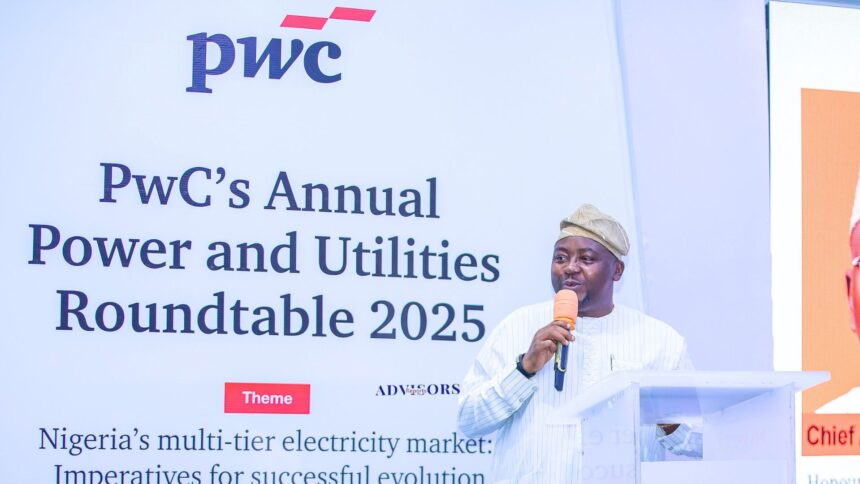
The Power Minister made this known at the PwC Power Roundtable in Lagos while speaking on the theme, “Nigeria’s Multi-Tier Electricity Market: Imperatives for Successful Evolution.”
Advisors Reports confirmed that the Nigerian Electricity Regulatory Commission (NERC) had initially issued 10-year operational licences to the Distribution Companies (DisCos), originally set to expire in 2023, but later extended by five years, pushing their validity period to 2028.
According to him, the DisCos will be required to present their performance improvement plans as part of the licence renewal process.
He stressed that the companies remain vulnerable, not bankable, and unable to provide the capital required to significantly reduce their ATC&C losses.
The Minister of Power, highlighting the dire financial and operational state of DisCos, stressed the urgent need for investment and structural reforms.
Adelabu described DisCos as vulnerable and unbankable due to negative balance sheets, making them unable to attract loans for critical infrastructure investment.
He noted that since their acquisition in 2013, most DisCos have failed to invest in reducing Aggregate Technical, Commercial, and Collection (ATC&C) losses, which currently average around 40 percent.
He emphasised that Eko Electricity (EKEDC) and Ikeja Electric have shown relative improvement compared to others, several DisCos have seen their losses worsen over the years.
Adelabu explained that the funds used to acquire these companies were borrowed, leaving them with little capacity to finance further investment needed to improve efficiency.
“Power infrastructure requires significant investment. Even countries with reliable systems like the US, Europe, South Korea, China, and Singapore continue to invest billions of dollars in their power sectors. Nigeria cannot afford to do otherwise,” he emphasized.
Adelabu stated that with minimum capital requirement, the DisCos must be able to present detailed performance improvement plans, specifying infrastructure upgrades, cost estimates, and funding sources.
The Minister stressed that addressing these challenges is critical not just for the power sector, but for national development as a whole, citing impacts on education, health, transportation, and aviation.
He praised the decisive approach of the Tinubu-led administration, acknowledging that initial difficulties are inevitable but expressing confidence that the reforms will yield long-term benefits.
“Reforming Nigeria’s power sector will require courage and boldness, adding that, “No one can have an omelette without breaking eggs.
“By addressing these challenges now, the Nigeria will reap lasting improvements in service delivery and national growth,” Adelabu said.