
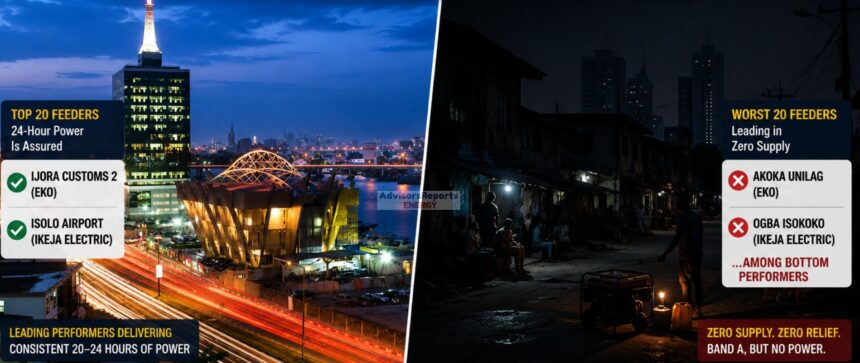
Eko Power’s IJORA Customs 2, Ikeja Electric’s Isolo Airport Lead, as Akoka UNILAG, Ogba Isokoko lag at the bottom
…from full-day supply to total outages, LASERC data exposes deep inequality within Lagos’ premium power band
Oredola Adeola
A wide performance gap defined Lagos’ electricity network in June 2026, with the top 20 feeders achieving near 24-hour supply while several others posted zero output, according to LASERC rankings of hundreds of feeders across both DisCos.
This was contained in the Lagos State Electricity Regulatory Commission (LASERC) June 2026 monthly factsheet, which detailed feeder performance rankings for the two major Lagos DisCos, Eko Power Limited and IE Energy Lagos Ltd., alongside their metering status and technical performance metrics, with further analysis by Advisors Reports.
The LASERC data highlights a stark contrast in electricity access across Lagos, with supply ranging from full 24-hour availability in top-performing feeders to zero supply in others, underscoring persistent inequalities in power distribution despite localized improvements in service delivery.
Advisors Reports gathered that these feeders represent the top performers for the period under review, with many other feeders also recording relatively high supply levels outside this group, exposing lack of compliance to the Banding order with evidence of uneven performance.
Eko Power Ltd recorded 10 top-performing feeders with a full 24-hour average daily supply, indicating uninterrupted electricity throughout the 30-day period.
These include Ijora TS – Customs 2, Blue Rail Line, Alagbon TS – Banana Island 2, Akangba TS – Adelabu 2, Ijora TS – Ajele 1, Alagbon TS – Anifowoshe/Ozumba Nbadiwe, Akangba TS – Awuwo/Coker, Guinea (Beta) Glass, Akangba TS – Awuwo, and Isolo TS – Isolo Local.
Similarly, Ikeja Electric recorded 10 leading feeders averaging 23.3 hours of daily supply, led by 33kV Isolo TCN – Airport.
Other feeders in this category include Isolo TCN – AFPRINT, Ikorodu TCN – Spintex, Ikorodu TCN – MTN, Egbin TCN – Maryland (Landcraft and Omnik), Isolo TCN – Pure Hygiene, Ikorodu TCN – Dangote, and Ejigbo TCN – Oke-Afa.
For Eko Power, Akoka TS – Akoka Local T3 emerged as the worst-performing feeder with zero supply throughout June.
Other weak feeders included Akangba TS – NRC/Prince Serve, Lekki TS – Argungi with about seven days of supply, Amuwo TS – Kirikiri Express/Vanguard with 11 days, and several Alagbon and Apapa Road feeders recording between 14 and 15 days of supply.
Some feeders, including Ijora TS – Courseway and Akangba TS – Randle/New Surulere, averaged about 10.6 hours of power during the month in view.
Under Ikeja Electric, several feeders recorded no supply throughout the month, including 11-Ogba INJ-T1 Isokoko, 11-Shasha INJ-T1 Coker Estate, 33-Ilupeju TCN – Ilupeju/Igbobi, and feeders within the Ogba and Igbobi injection substations.
Others such as Igbobi INJ-T3 – Railway recorded supply for only one day in the month, while some feeders averaged just two to 13 days of supply, with an overall low average of about 7.2 hours daily in this category.
Advisors Reports’ review of the customer and metering data further highlight structural gaps.
Eko Power recorded 817,618 customers, with 563,522 metered, representing a 70 percent metering rate, after installing 4,650 new meters in June.
Within its customer bands, 195,211 Band A customers were metered, alongside 262,114 in Band B, 135,727 in Band C, 178,911 in Band D, and 43,655 in Band E.
Ikeja Electric, with 1,304,195 customers, achieved a higher metering rate of 86 percent, with 1,124,980 customers metered, but added only 611 new meters during the period under review.
Its metered customers include 314,470 in Band A, 410,182 in Band B, 352,878 in Band C, 226,071 in Band D, and 594 in Band E.
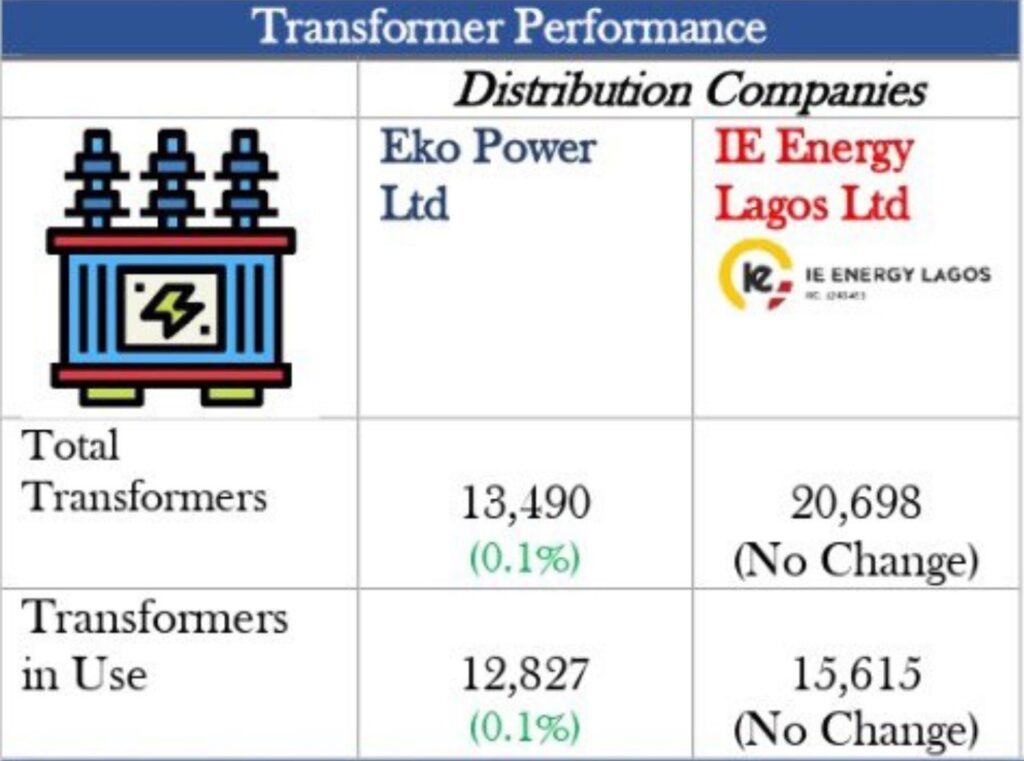
On infrastructure, Eko Power operates 13,490 transformers, with 12,827 currently in use (about 95%), reflecting near-full asset deployment and a marginal 0.1 percent increase in both total stock and utilisation.
In contrast, Ikeja Electric (IE) has a significantly larger base of 20,698 transformers but only 15,615 are in active use (about 75%), indicating a wider idle capacity gap and no recorded expansion during the period under review.
On outages recorded during the period under review, Eko recorded 2,287 planned incidents and 2,307 unplanned outages, compared to Ikeja Electric’s 3,418 unplanned outages and 3,584 load shedding cases, despite overall declines.
In terms of fault management, Eko Power showed strong improvements in clearing 11kV faults within six hours, rising by 112 percent, while 33kV fault resolution also improved.
Conversely, Ikeja Electric’s fault-clearing performance weakened, with declines of 14.4 percent on 11kV and 28 percent on 33kV networks, pointing to slower response times in addressing technical disruptions.
These dynamics fed directly into customer experience outcomes.
Eko Power recorded 8,020 customer interruption incidents, affecting over 769,000 customers, representing a steep increase driven largely by planned outages.
Meanwhile, Ikeja Electric posted significantly fewer interruptions at 967 cases, impacting just 4,591 customers, reflecting its reduced outage frequency but also possibly narrower reporting coverage or feeder concentration.
LASERC, following the transition order by the Nigerian Electricity Regulatory Commission (NERC) and having assumed active oversight of Lagos’ electricity market, has emphasised its regulatory stance that poor performance will attract consequences.
Under the Service-Based Tariff (SBT) Order, now enforced by LASERC, the two major DisCos in Lagos are required to consistently meet the minimum Band A supply threshold or face sanctions, including tariff downgrades, financial penalties, and possible feeder reclassification where service obligations are not met.