
.. says “no electricity without gas, Nigeria can’t transform on renewables alone”
Oredola Adeola
Mr. Rogers Brown, Chief Executive Officer of Seplat Energy Plc, has called for the harmonisation of Nigeria’s gas sector legislation and clearer definition of the government’s role, as growing investor interest highlights the need for a coordinated and transparent regulatory framework.
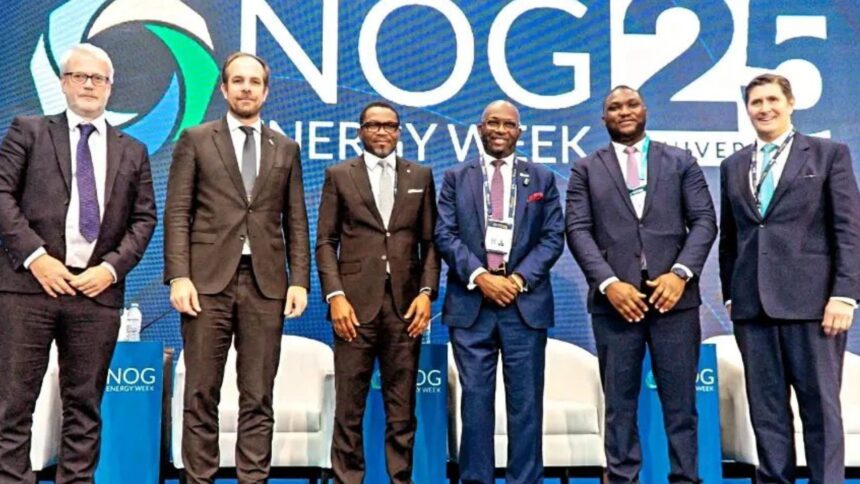
Brown made this known on Tuesday during Day One of the Strategic Conference at NOG Energy Week 2026, where he spoke at the fifth panel session titled “Advancing Energy Ambitions for Competitive & Resilient Economies.”
The CEO of Seplat Energy Plc further emphasised that aligning policies across the entire gas value chain is critical to sustaining growth and attracting long-term investment.
According to him, Nigeria’s gas industry has undergone a significant transformation over the past decade, evolving from a largely overlooked segment into a fully-fledged and dynamic sector capable of supporting multiple Gas Sales Agreements (GSAs).
“Ten years ago, there were very few participants in Nigeria’s gas space, and limited interest in gas development. Today, the sector has transformed into a full industry with diverse players across the value chain,” he said.
Brown also noted that while foundational frameworks such as the Gas Master Plan, the Petroleum Industry Act (PIA), and the Decade of Gas (DoG) initiative have laid groundwork for the gas industry, he added that more work is required to fully align legislation and ensure seamless coordination across upstream, midstream, and downstream segments.
He further explained that gas development cannot be approached in isolation due to its interdependence with multiple sectors, including power generation, transportation through compressed natural gas (CNG), clean cooking via liquefied petroleum gas (LPG), and industrial applications such as petrochemicals and fertiliser production.
“The challenge is to align legislation across all these segments so that every player is operating within a consistent framework. It is still a work in progress, but the direction is encouraging,” he added.
Brown also emphasised the critical role of gas in Nigeria’s economic development, particularly in addressing the country’s long-standing power deficit.
He noted that no economy can grow sustainably without reliable electricity, and gas remains the most viable energy source to drive large-scale power generation in Nigeria.
“Every sector including education, manufacturing, employment, depends on power, and that power will not materialise without gas.
“The power is not going to materialise without the gas. Because quite frankly, we’re not going to transform Nigeria with renewable energy.
“That’s certainly not going to happen. But you need that gas basically,” he said.
Speaking on financing for the gas sector, Brown noted that NNPC Ltd’s Gas Master Plan (NGMP 2026), which targets catalysing over $60 billion in investments across the oil and gas value chain by 2030, may be insufficient.
He stressed that significantly higher capital outlays would be required to fully develop the sector, and called for improved access to long-term, affordable financing to support critical infrastructure investments.
“The scale of investment required is substantial, and capital must be accessible, patient, and competitively priced. Bridging this financing gap will be crucial to sustaining momentum in the sector,” he said.
The Seplat Energy CEO noted that while progress has been made, sustained collaboration between government, regulators and private sector players will be critical to fully unlock the potential of Nigeria’s gas industry.
“There has been a strong start, but the work is not finished. Government must continue to refine the regulatory environment in tandem with industry stakeholders to ensure sustained growth,” Brown added.