
… flags underutilised in-country capacity, limited drilling activity as investment gap widens
Oredola Adeola
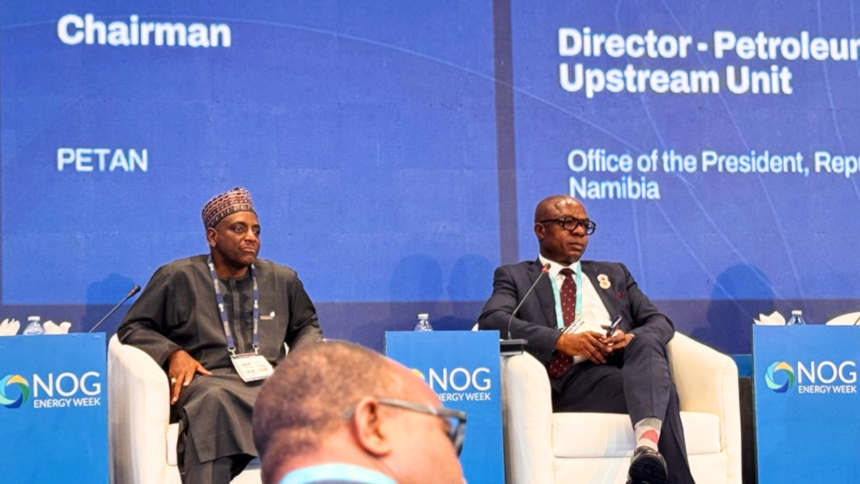
Engr. Wole Ogunsanya, President of the Petroleum Technology Association of Nigeria (PETAN), has warned that Nigeria risks missing its target of ramping up crude oil production to 3 million barrels per day by 2030, as operators lose up to 70% of hydrocarbon output due to underutilised in-country capacity, limited drilling activity and funding constraints.
Ogunsanya made this known on Monday at the Nigerian Content Seminar, held on the sidelines of the ongoing Nigerian Oil and Gas (NOG) Energy Week, during a Strategic Panel Session themed “Nigerian Content as an Investment Enabler.”
He noted that while Nigeria has built significant local capacity across the oil and gas value chain—spanning drilling, fabrication, and supply chain services—much of this capacity remains underutilised due to a slowdown in investments and insufficient project pipeline.
According to him, achieving the country’s production targets will depend largely on scaling up drilling activities across onshore, shallow water, and offshore assets, as well as ensuring sustained capital inflow into the sector.
“We have adequate equipment and in-country capacity to achieve up to 3 million barrels per day production. The challenge is how to fully utilise this capacity.
“Without increased drilling and investment, those targets may remain out of reach,” he said.
Ogunsanya disclosed that despite Nigeria’s growing refining footprint—including Dangote Refinery, the rehabilitated Port Harcourt , Kaduna and Warri refineries, and proposed new projects—the upstream segment has not kept pace, creating a mismatch between production potential and actual output.
He attributed the slowdown in upstream investments to operational inefficiencies and losses, noting that in some cases operators lose up to 70 percent of production, a situation that discourages further capital deployment.
“This is at the core of the industry’s challenge. Investors will be reluctant to commit funds where production losses are significant. We must address these structural issues to unlock growth,” he stated.
On financing, the PETAN President described access to capital as a critical enabler for expanding production, stressing the need for more targeted funding frameworks to support asset development and equipment deployment.
He disclosed that PETAN members have partly benefited from over $20 billion in local content financing initiatives facilitated by the Nigerian Content Development and Monitoring Board (NCDMB), which have supported investments in drilling, fabrication, and broader supply chain development.
“These interventions have helped retain capital within the country and strengthened indigenous capacity.
“However, we need more dedicated funding for critical equipment and, more importantly, projects that will utilise these assets effectively,” he said.
Ogunsanya also acknowledged the increasing role of Nigerian financial institutions in supporting the sector, citing recent moves by international oil companies to engage local banks for contractor financing.
He emphasised that a stronger project pipeline is essential not only to boost production but also to ensure optimal utilisation of existing world-class equipment and deepen local capacity.
“We need more projects. When projects increase, equipment utilisation improves, and indigenous companies can scale their capabilities. That is how we build a sustainable industry,” he added.
Reaffirming PETAN’s commitment to industry growth, Ogunsanya assured stakeholders, including international oil companies, that its members are well-positioned to deliver on projects and maximise the impact of available funding.
The PETAN President emphasised that Nigeria could achieve its medium- and long-term production targets and strengthen its position in the regional and global oil and gas market if the government addresses fundamental challenges, particularly those affecting investment flows and the acceleration of drilling activities.