
…project set to deliver 2bn scf/d capacity, strengthen East–West gas connectivity, improve nationwide supply flow
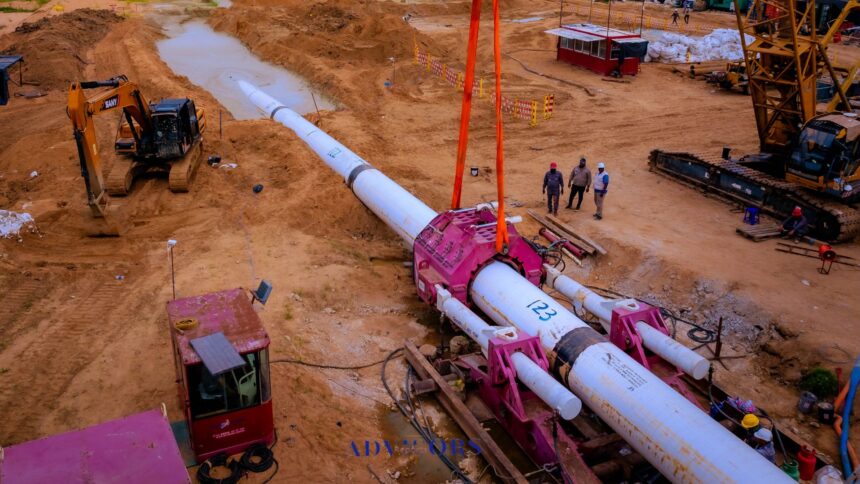
The NNPC Gas Infrastructure Company (NGIC), a subsidiary of NNPC Limited, has completed the River Niger crossing on the $700 million, 48-inch, 130-kilometre Obiafu-Obrikom-Oben (OB3) gas pipeline, a key infrastructure project designed to transport up to 2 billion standard cubic feet of gas per day.
Final completion of the project is expected to strengthen East–West gas connectivity and ensure efficient supply from production hubs to demand centres across Nigeria.
Andy Odeh, NNPC Ltd. Chief Corporate Communications Officer made this known in a statement obtained by Advisors Reports on Thursday, a development marking a major milestone in the expansion of Nigeria’s national gas transmission network.
According to him, the successful crossing unlocks the full potential of the OB3 Pipeline, significantly strengthening energy availability, enhancing supply reliability, and accelerating national economic development.
Odeh noted that the River Niger crossing was executed approximately two kilometres beneath the River Niger riverbed, the technically complex crossing was delivered by the NNPC project team working with PCE Nig. Limited, using advanced horizontal directional drilling (HDD) technology.
Engr. Bashir Bayo Ojulari, Group Chief Executive Officer of NNPC Limited, commending the achievement, described the milestone as a testament to disciplined execution and technical excellence.
According to him, “The completion of the OB3 River Niger Crossing is a defining milestone for Nigeria’s gas infrastructure and a clear demonstration of what disciplined execution and sustained commitment to excellence can deliver.
By successfully traversing one of the most technically challenging sections of the project, we have unlocked a critical link that will enhance gas supply reliability, deepen domestic utilisation, and support power generation and industrial growth across the country.”
Engr. Ojulari noted that the achievement builds on NNPC Limited’s growing engineering and execution capability, drawing from the successful AKK River Niger Crossing in June 2025, to deliver an even more complex crossing in the Niger Delta environment.
“This achievement is not incidental. It is the result of deliberately leveraging and upscaling our AKK engineering and execution excellence through rigorous project governance, innovative engineering solutions, adaptive problem-solving, and the unwavering commitment of our teams and PCE Nig. Limited.
The OB3 Pipeline is central to our ambition of building an integrated and resilient gas network that underpins Nigeria’s energy security and economic development. I commend everyone involved for their doggedness and for staying the course to deliver this strategic national asset.”
The GCEO further acknowledged the critical support of key stakeholders, stating: “We sincerely appreciate the continued support of President Bola Tinubu, whose Gasto-Prosperity agenda and commitment to a conducive business environment have been instrumental in making this achievement possible.
NNPC Limited could also not have achieved this feat without the trust and guidance of its Board of Directors, under the leadership of our Chairman, Engr. Ahmadu Musa Kida.”
Reaffirming NNPC Limited’s national mandate, Engr. Ojulari added: “At NNPC Limited, we remain fully committed to translating Nigeria’s oil and gas resources into a better standard of living for all citizens.
We will continue to collaborate with our partners to deliver projects that expand energy availability, stimulate industrialisation, and improve the overall wellbeing of Nigerians.”
He expressed his sincere appreciation to the host community for its consistent support towards the project; the management and staff of NGIC for their doggedness in achieving the milestone; and PCE Nig. Limited for its professionalism, noting that the contractor’s innovative approach and disciplined workforce were pivotal to the project’s success.
The GCEO further highlighted the strategic significance of the milestone against the backdrop of the Federal Government’s oil and gas production growth targets of 3 million barrels of crude oil per day and 12 billion standard cubic feet of gas per day by 2030.
The successful River Niger Crossing ensures that Nigeria’s gas producing regions are now physically interconnected with the rest of the country.
The OB3 Pipeline, with a capacity of 2 billion standard cubic feet per day, serves as a backbone gas infrastructure linking the Eastern gas network to the Western network and extending connectivity to the Northern corridor through the AKK Pipeline.
In the near term, the successful crossing is expected to unlock over 500 million standard cubic feet of incremental gas supply for the domestic market, supporting power generation, industrial growth, and gas supply to the West African market.