

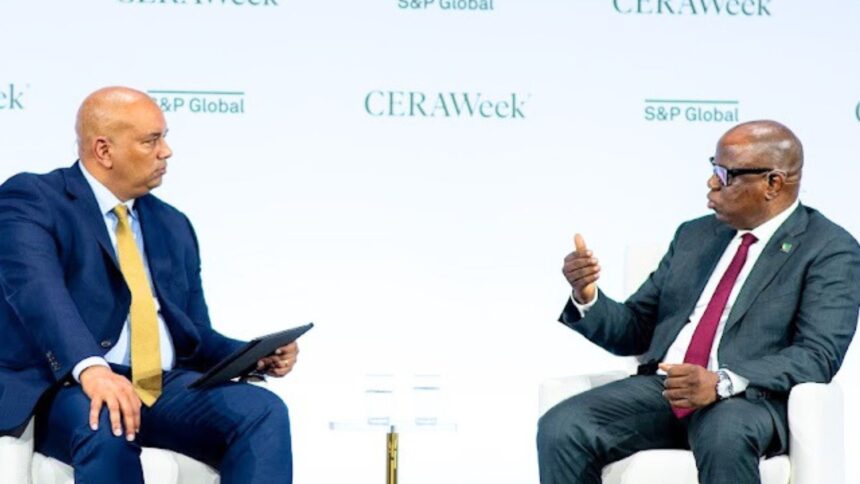
… says partnerships with global players will drive large-scale production
Oredola Adeola
Engr. Bashir Bayo Ojulari, Group Chief Executive Officer of NNPC Limited, has reaffirmed that Nigeria’s deepwater oil segment remains a strategic priority due to its ability to deliver large-scale production.
Ojulari made this remark while speaking on the opening day of at CERAWeek 2026, world’s premier energy gathering, held under the theme “Convergence and Competition: Energy, Technology and Geopolitics,” in Houston, Texas.
He identified partnerships in de-risking Nigeria’s deepwater assets, noting that global players like Shell and Eni bring not only capital but execution capability, technology, and project discipline—particularly for assets like OPL 245 and other deepwater developments.
The NNPC GCEO explained that the Petroleum Industry Act (PIA) has now firmly established regulatory certainty, while infrastructure gaps are being closed through targeted investments and security is being strengthened through a more robust architecture.
“When the fundamentals are right, partnerships scale naturally,” he added.
According to him, Nigeria’s fundamentals are strong, its value proposition clear, and its focus now squarely on execution.
He said, “Nigeria’s strategy is grounded in realism, partnership, and disciplined delivery.”
“Capital goes where value is clear, and Nigeria has that value,” Ojulari stated.
The NNPC GCEO further said, “Nigeria is the reliable destination for energy investment the world needs.
“The country has positioned itself as a dependable supplier, riding on the established legacies of stable policies, improved energy infrastructure security, partnerships, and, lastly, the orientation of the government.
“The President has given NNPC the autonomy to act on its behalf and consolidate commercial solutions that are long-lasting.”
“Balance is not about equal allocation; it is about optimal sequencing,” Ojulari stated, outlining a portfolio where oil sustains value today, gas underpins industrial growth, and transition investments are targeted and disciplined.
Addressing Nigeria’s long-discussed gas potential, the GCEO noted that what is different now is execution discipline.
“Three key enablers are receiving focused attention: commercial pricing across the value chain, critical infrastructure like the AKK (Ajaokuta-Kaduna-Kano) pipeline, and bankable contracts that provide investor certainty.
“On the balance between domestic gas needs and LNG exports, Engr. Ojulari described a dynamic approach of portfolio optimisation—allocating gas where it delivers the highest combined national and commercial value.
The GCEO articulated a clear strategic shift, moving from resource ownership to resource monetisation.
He emphasized that unlocking Nigeria’s significant proven but undeveloped reserves requires commercial discipline, competitive fiscal frameworks, and strong partnerships. Deepwater remains a priority because it offers scale, it is less exposed to onshore challenges, and attracts global capital.