… identifies infrastructure investment, pricing reforms as key to affordability, adoption
Oredola Adeola
Barrister Edu Inyang, President of the Nigerian Association of Liquefied Petroleum Gas Marketers (NALPGAM), has attributed Nigeria’s sustained decline in cooking gas import dependence to the growing contributions of key domestic producers, including NLNG, Dangote, Seplat, Kwale Hydrocarbon, and NPDC Ologbo.
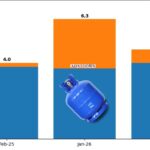
Speaking with Advisors Reports on the sidelines of recent industry developments—where domestic producers accounted for 59% of LPG supply in January 2026 and surged to 85% in February as imports declined—Inyang described local operators as “game changers” in Nigeria’s liquefied petroleum gas market.
He noted that the increasing output from the domestic players is helping to position the country toward achieving its target of five million metric tonnes of LPG consumption annually by 2030, in line with the Energy Transition Plan (ETP).
According to him, domestic supply accounted for an average of 71.9 per cent of total LPG supply between January and February 2026, compared to imports, which made up 28.1 per cent over the same period.
This marks a significant shift in market dynamics, with local production increasingly displacing imports.
Inyang identified several factors driving the trend, including increased local production and expanded refining and gas processing capacity—particularly from the Dangote Refinery and NLNG.
He also highlighted supportive government policies such as the zero import duty on LPG equipment and initiatives under the National Gas Expansion Programme (NGEP), which have incentivised local production and reduced reliance on imports.
He further noted that rising public awareness of LPG as a cleaner cooking fuel, alongside growing health concerns associated with traditional fuels such as firewood, has contributed significantly to increased adoption.
“In addition, infrastructure development—driven by both public and private sector investments—has played a critical role.
“This includes the expansion of LPG refilling plants, bulk storage facilities, and distribution networks across the country.
“This growth appears sustainable, given Nigeria’s ambitious target of five million metric tonnes of LPG consumption annually by 2030, in alignment with the Energy Transition Plan,” Inyang said.
The NALPGAM President emphasised the need for continued collaboration between government and private sector stakeholders to deepen market penetration.
Key priorities, according to him, include expanding storage and transportation infrastructure to improve nationwide access.
He also underscored the importance of affordability, calling for the implementation of pricing frameworks and structured incentives to make LPG more accessible to households.
He explained that sustaining the current momentum will depend on consistent policy support, infrastructure expansion, and market-driven pricing mechanisms capable of balancing supply growth with consumer affordability.
He therefore called for the expansion of alternative uses of LPG, particularly in transportation through Autogas and across key industrial applications, as part of efforts to deepen domestic gas utilisation.
Speaking further in his engagement with Advisors Reports, Inyang noted that government-backed initiatives such as the Decade of Gas Initiative and the National Gas Expansion Programme (NGEP) are central to driving this transition.
He stated that continued growth in local production and ongoing infrastructure investments could support further price moderation in the domestic LPG market.
“Nigeria’s LPG infrastructure development is gaining momentum, driven by a combination of government policies and private sector investments,” he said.
Inyang also referenced the recently unveiled Gas Master Plan 2026 by the Nigerian National Petroleum Company (NNPC) Limited, which targets an increase in national gas production to 10 billion cubic feet per day by 2027 and 12 billion cubic feet per day by 2030.
According to him, the plan prioritises infrastructure expansion, domestic market growth, and strategic partnerships to unlock value across the gas value chain.
The NALPGAM President expressed confidence that Nigeria’s growing domestic dominance in LPG supply would be sustained, particularly with the completion of critical infrastructure projects.
These include six new gas processing plants currently under development, alongside two facilities designed to convert flared gas into usable fuel.
Additional projects in the pipeline include the rollout of three compressed natural gas (CNG) refueling stations aimed at addressing transportation bottlenecks, as well as the development of a bulk LPG storage facility to enhance supply chain efficiency.
He further highlighted the ongoing Victoria Island–Lekki natural gas pipeline project, which is expected to improve gas access for industries and households within the corridor, thereby supporting broader energy access objectives.
Inyang urged the Federal Government to remain committed to its gas-focused policy frameworks, including the Decade of Gas Initiative, which positions natural gas as a transition fuel for economic growth; the National Gas Expansion Programme, which prioritises infrastructure development; and the Midstream and Downstream Gas Infrastructure Fund (MDGIF), which provides financing support for critical gas projects.
He emphasised that the successful implementation of these initiatives would not only accelerate cooking gas adoption but also contribute to reducing energy costs, enhancing energy security, and driving overall economic growth.
Edu noted that cooking gas marketers are optimistic about the impact of the Dangote Refinery on Nigeria’s domestic gas market, citing its ongoing expansion and planned second processing train as key drivers of increased supply.
They noted that the refinery’s planned expansion—from 650,000 to 1.4 million barrels per day—will significantly boost LPG production, aligning with Nigeria’s National Gas Policy objectives of deepening domestic utilisation and enhancing energy security.