
Advisors ReportsAdvisors Reports
  • News
  • Editorial
  • Feature
  • Special Report
  • Oil & Gas
    • Upstream
    • Midstream
    • Downstream
  • Power
    • Generation
    • Distribution
    • Transmission
  • Renewables
    • Solar
    • Nuclear
    • Hydrogen
  • Extractive Industry
  • Maritime
Search

Archives

  • March 2026
  • February 2026
  • January 2026
  • December 2025
  • November 2025
  • October 2025
  • September 2025
  • August 2025
  • July 2025
  • June 2025
  • May 2025
  • April 2025
  • March 2025
  • January 2025
  • December 2024
  • November 2024
  • October 2024
  • September 2024
  • August 2024
  • July 2024
  • June 2024
  • May 2024
  • April 2024
  • March 2024
  • February 2024

Categories

  • Advertorial
  • Concession
  • Distribution
  • Documentary
  • Downstream
  • Editorial
  • Energy Transition
  • Environment
  • Extractive Industry
  • Feature
  • Finance
  • Gas
  • Generation
  • Green Finance
  • Hospitality
  • Hydrogen
  • Hydroplant
  • Impact
  • Interview
  • Local Content
  • Maritime
  • Midstream
  • Mining
  • Mining & Solid Mineral
  • Multilateral Finance
  • News
  • Nuclear
  • Oil
  • Oil & Gas
  • Oil theft
  • Opinion-editorial
  • Photo News
  • Power
  • Renewables
  • Review
  • Sabotage
  • Security
  • Service Company
  • Solar
  • Special Project
  • Special Report
  • Sustainability
  • Technology
  • Transmission
  • Upstream
© 2022 Foxiz News Network. Ruby Design Company. All Rights Reserved.
Reading: Cooking gas market shifts: NLNG, Dangote, others supply 85% as imports drop to 15% in Feb. 2026
Share
Sign In
Notification Show More
Font ResizerAa
Advisors ReportsAdvisors Reports
Font ResizerAa
Search
Have an existing account? Sign In
Follow US
© 2022 Foxiz News Network. Ruby Design Company. All Rights Reserved.
DownstreamMidstreamNewsOil & Gas

Cooking gas market shifts: NLNG, Dangote, others supply 85% as imports drop to 15% in Feb. 2026

admin
admin
Share
3 Min Read
SHARE

…consumption drops 17% as retail prices remain stable: Jan ₦950–₦1,550/kg vs Feb ₦980–₦1,500/kg

Oredola Adeola

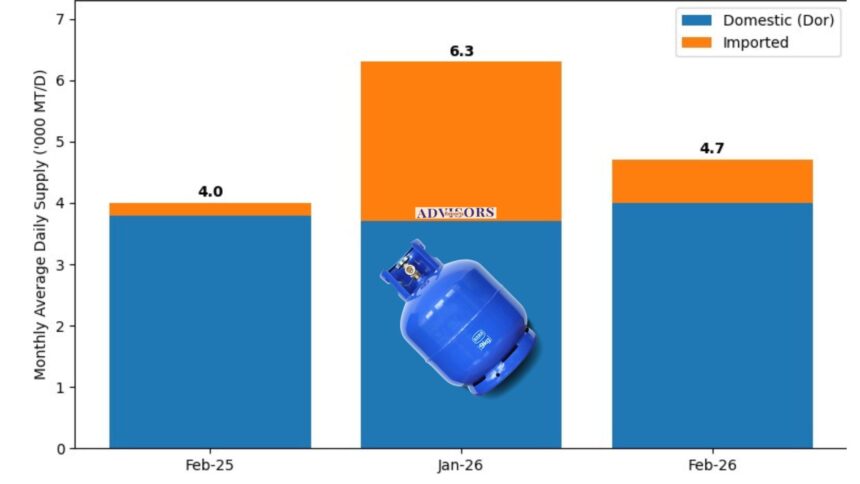
In February 2026, domestic producers—including the Dangote refinery, NLNG, and other local gas suppliers—accounted for approximately 85% of Nigeria’s total Liquefied Petroleum Gas (LPG) supply, contributing about 4,000 metric tonnes per day (MT/day), while imports made up the remaining 15% at 700 MT/day.

- Advertisement -
Ad image

This revealed a strong and steady contribution from gas processing plants and the Dangote Petroleum Refinery and Petrochemicals complex (DPRP).

This was revealed by the Nigerian Midstream and Downstream Petroleum Regulatory Authority (NMDPRA) in its State of the Downstream Sector Fact Sheet for February 2026, compared with the data obtained by Advisors Reports in January.

Overall, the country’s average daily cooking gas supply for the month stood at 4,700 MT/day, compared to 6,300 MT/day recorded in January 2026.

The data showed a sharp decline in import dependency in February relative to January, with imports dropping from about 41% of total supply in January to 15% in February.

Domestic supply on the other hand increased its share from roughly 59% to 85%, even as total volumes moderated month-on-month.

Further analysis of the data shows that average daily cooking gas (LPG) truck-out declined to 4,194 MT/day in February 2026, compared to 4,860 MT/day recorded in January, indicating a moderation in downstream offtake.

Similarly, average daily consumption dropped to 4,194 MT/day in February from 5,050 MT/day in January, reflecting a broader slowdown in market activity.

Retail prices remained relatively stable across both months, with LPG selling between ₦950 and ₦1,550 per kilogram in January, compared to a slightly narrower range of ₦980 to ₦1,500 per kilogram in February.

On a year-on-year basis, domestic supply strengthened, with local producers delivering an average of 4,000 MT/day in February 2026, up from 3,800 MT/day in February 2025.

Imported volumes also increased year-on-year, rising to 700 MT/day from 200 MT/day over the same period.

However, month-on-month data highlights a sharp contraction in imports, which dropped significantly from an average of 2,600 MT/day in January 2026 to 700 MT/day in February, reinforcing the growing dominance of domestic supply.

Consistent with earlier trends, the February 2026 factsheet further confirms that throughout 2025 and into the first two months of 2026, Nigerian producers have remained the primary source of LPG supply.

In several peak periods—including February, March, and July—local production met nearly all national demand, with imports either minimal or entirely absent.


Sign Up For Daily Newsletter

Be keep up! Get the latest breaking news delivered straight to your inbox.
[mc4wp_form]
By signing up, you agree to our Terms of Use and acknowledge the data practices in our Privacy Policy. You may unsubscribe at any time.
Share This Article
Facebook Copy Link Print
Share
Previous Article “Only a contestable market can protect Nigeria from Middle East–driven volatility” – Nwakwue at MEMAN/S&P webinar
Leave a Comment Leave a Comment

Leave a Reply Cancel reply

You must be logged in to post a comment.

Recent Posts

  • Cooking gas market shifts: NLNG, Dangote, others supply 85% as imports drop to 15% in Feb. 2026
  • “Only a contestable market can protect Nigeria from Middle East–driven volatility” – Nwakwue at MEMAN/S&P webinar
  • India, Nigeria show the way to electrifying the global south
  • S&P Global, MEMAN warn Nigeria on energy risks, urge reserves, supply diversification
  • GenCos raise alarm as generation varies from 3,480MW to 4,130MW

Recent Comments

No comments to show.
Follow US
© 2022 AdvisorsReports. All Rights Reserved.
Welcome Back!

Sign in to your account

Username or Email Address
Password

Lost your password?