

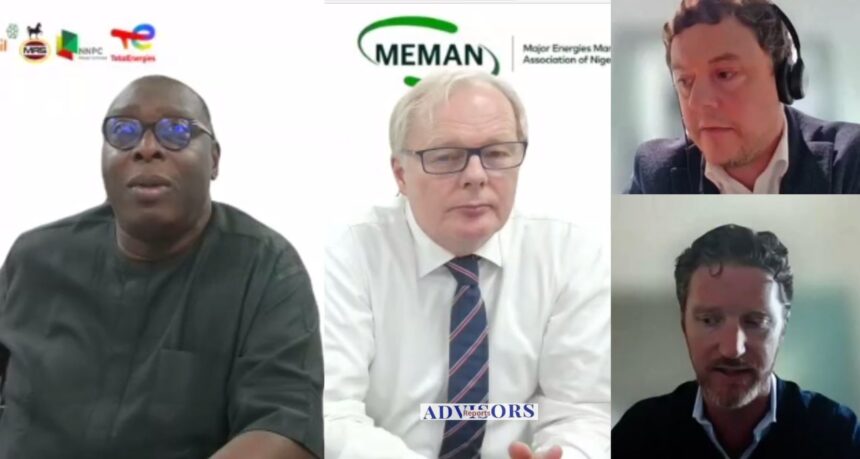
Actions taken now will shape West Africa’s energy trajectory for years to come” – Stokman
“Strategic reserves must act as a buffer to protect markets in times of disruption” – Clark
“Nigeria must build adequate strategic stocks if it is to withstand global supply shocks” – Drochon
Oredola Adeola

Energy experts from S&P Global and MEMAN have warned that Nigeria and the wider West African region must urgently strengthen energy security through strategic petroleum reserves, supply diversification, a well-regulated market framework, and sustained investment in refining and infrastructure.
The recommendations come amid rising concerns over price volatility and potential disruptions to Iranian crude oil output, as ongoing U.S.–Israel–Iran tensions heighten instability in the global energy market and expose the downstream sector to supply and pricing shocks.
This was the key highlight of a virtual webinar organised by the Major Energy Marketers Association of Nigeria in partnership with S&P Global, titled “West African Market Resilience in the Face of Geopolitical Situation.”
The session examined how global tensions are shaping refined product markets and the resilience of West Africa’s downstream oil sector.
Mr. Huub Stokman, Chairman of MEMAN stressed that actions taken now uncertainty currently facing global energy markets, could shape West Africa’s energy trajectory for years to come.
Stokman who doubles as the Managing Director of NNPC Retail Limited revealed that, as Africa’s largest oil producer, Nigeria—with its high-quality crude, growing refining capacity, including the operational Dangote Refinery, and an increasingly sophisticated domestic market—is well-positioned to become a reliable and strategic global energy partner.
“To capitalize fully on this moment, the country and region must address key issues such as pipeline security, production consistency, regulatory transparency, and infrastructure investment,” he said.
“West Africa is resilient, and this region has consistently demonstrated its capacity to adapt, innovate, and grow even in adverse environments.”
He also commented on recent price movements, noting that the Middle East crisis, though only two weeks old, has already influenced volatility.
“Prices in Nigeria have largely followed import parity with the international market. Nobody can predict exactly what will happen next,” he said.
Stokman emphasized the importance of stable and predictable pricing mechanisms, citing Ghana as an example: “Ghana allows prices to adjust every two weeks, and it is working.
“Frequent or arbitrary price changes—especially multiple times in a day—are aberrations that do not align with global industry standards. We must follow best practices while considering the benefits for our country.”
He concluded by reaffirming MEMAN’s commitment to addressing emerging issues and ensuring that Nigeria’s energy market remains resilient, competitive, and aligned with global trends.
Speaking at the event, Gary Clark, Associate Director for EMEA Clean Refined Products, questioned whether Nigeria could be insulated from global market volatility, even with the operational capacity of the Dangote Refinery.
Clark highlighted that strategic petroleum reserves play a dual role: they provide a buffer during supply shocks through timely release of stored products, and they support supply chain diversification, reducing overreliance on any single crude source or region.
“Strategic reserves are not just for storage—they are policy tools. Their release during disruptions helps stabilise prices, while their existence supports supply diversification and energy security,” Clark said.
He also noted that while domestic refining capacity offers some protection, Nigeria’s oil market remains connected to global dynamics.
He questioned whether the advantages enjoyed by the Dangote Refinery, particularly access to crude priced in naira under government concessions, would translate into broader market stability and consumer benefits.
Stanislas Drochon, Africa Head of Fuels and Refining at S&P Global, said energy security across Sub-Saharan Africa must be anchored on reliability, affordability, and accessibility.
He emphasised that adequate strategic storage capacity is critical, particularly for managing short-term disruptions.
However, he expressed concern that Nigeria currently lacks sufficient reserves, noting that the country does not maintain up to the internationally recommended 90 days of strategic petroleum stocks, hence the need to start considering investment in this.
Drochon warned that if the Middle East crisis escalates—especially around key chokepoints such as the Strait of Hormuz—it could trigger significant supply disruptions for many African countries that rely heavily on imports and lack strategic buffers.
In the short term, he explained that Nigeria, despite its advantages as a major crude oil, LNG, LPG, and petroleum products exporter, must still strengthen its domestic supply security framework.
He also cautioned that rising supply costs could translate into higher fuel prices, with potential social and political consequences.
This, he said, could increase pressure on governments to reintroduce fuel subsidies, a move that may come with its own economic and fiscal challenges.
Drochon further noted the risk of fuel smuggling and inflows of off spec or discounted products, particularly in a volatile pricing environment.
Despite these risks, he highlighted opportunities for Nigeria to leverage its position by developing into a stronger regional hub for refined product exports, LNG, and bunkering services, similar to smaller but strategically positioned markets in West Africa.
He concluded by warning that uncertainty remains high, and delays in policy and infrastructure decisions could worsen the situation.
“Time is not on our side—the longer the uncertainty persists, the greater the risks to supply security and price stability for both consumers and governments. Strategic reserves are expected to play a critical role in cushioning these shocks,” he said.
Long-term fuel security according to him in the region will depend on sustained investment in refining, storage, and supply chain infrastructure.
He said, “A key strategy is diversifying supply sources by expanding refineries, strengthening ports and import terminals, and improving transportation networks.
“This broader and more flexible supply chain will enhance resilience and ensure reliable energy supply during periods of global volatility,” Drochon said.