
… how carbon credits, carbon offsets could be used to close electricity deficit gap? – AEPCCP President explains
“… Cambodia, Peru, and Colombia have already mobilized significant funding through forest protection and carbon trading schemes to finance renewable energy, rural electrification, and community development,”
Oredola Adeola
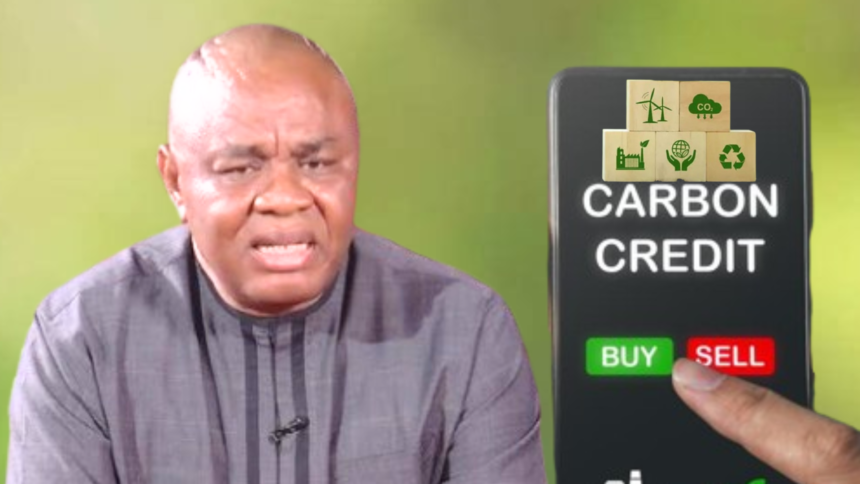
AVM (Rtd) Akugbe Iyamu, President of the Association of Environmental Protection and Climate Change Practitioners, has identified carbon trading schemes as one of the most underutilized climate financing mechanisms that can be strategically deployed to fund power infrastructure, renewable energy, rural electrification and community development projects in Nigeria and across Africa.
He emphasised that Africa’s energy transition must be guided by the three critical pillars of Affordability, Acceptability, and Availability, alongside a deliberate focus on carbon credits and carbon offsets as financing tools.
Iyamu made this comment during a panel session at the recent 9th edition of Nigeria International Energy Summit held in Abuja.
He emphasized that closing the country electricity deficit gap will require sustainable financing pathways and long-term environmental responsibility.
According to him, when managed strategically, these instruments can become powerful mechanisms for addressing energy poverty across the continent.
Using Nigeria as an example, Iyamu noted that while the country currently generates just over 5,000 megawatts of electricity, national demand exceeds 20,000 megawatts, with ambitions to scale significantly in the coming years.
He therefore noted that achieving that expansion will require sustainable financing pathways and long-term environmental responsibility.
He observed that recent global climate assessments confirm that 2024 was the hottest year on record, underscoring the urgency of climate action.
“Yet, global climate negotiations continue to place disproportionate emphasis on fossil fuel phase-outs without sufficiently empowering developing countries to define indigenous transition pathways that align with their development realities,” he said.
According to him, many climate commitments adopted at international platforms — including the COP process — are often replicated without adequate national ownership or localized implementation strategies.
The fundamental question, he said, remains: How do African nations rescue both the environment and their economies simultaneously?
Iyamu emphasized that carbon finance, particularly carbon credits and offsets, represents one of the most underutilized climate financing mechanisms available to Nigeria and Africa.
“Carbon credits reward countries and institutions for verifiable reductions in greenhouse gas emissions or for conserving carbon sinks such as forests, mangroves, and wetlands.
“Globally, governments and corporations are increasingly turning to carbon markets to complement their decarbonization strategies.
“Countries such as Cambodia, Peru, and Colombia have already mobilized significant funding through forest protection and carbon trading schemes to finance renewable energy, rural electrification, and community development,” he said.
Nigeria, he argued, can replicate these models.
He said, “With vast mangrove forests, wetlands, shorelines, and waste-to-energy potential, Nigeria possesses natural assets capable of generating billions of dollars annually through properly structured carbon market participation — funds that can be reinvested into renewable energy, grid expansion, and clean cooking solutions.”
AVM Iyamu further noted that Small and Medium Enterprises (SMEs) account for over 90 percent of businesses in Nigeria and contribute nearly half of national GDP, making affordable and reliable energy indispensable to economic growth, job creation, and poverty reduction.
He also cited recent global estimates showing that climate-related disasters caused over $200 billion in economic losses in 2024, reinforcing the reality that climate inaction is now one of the most significant threats to global stability and development.
This reality, according to him, was reflected in major global forums such as the World Economic Forum, where extreme weather events have become a top-tier global risk.
While acknowledging Nigeria’s introduction of Compressed Natural Gas (CNG) as a transport fuel alternative, AVM Iyamu cautioned that such measures should remain transitional.
He stressed that electric vehicles (EVs), renewable energy systems, and battery storage technologies offer more sustainable long-term solutions and that Nigeria must invest aggressively in building domestic technological capacity to support them.
He also referenced concerns raised at recent COP meetings about the growing influence of fossil fuel lobbying, which continues to slow global climate ambition and distort transition priorities — especially for vulnerable developing economies.
Commending President Bola Tinubu’s stated ambition to generate significant revenues from carbon markets, AVM Iyamu said the target is achievable if Nigeria adopts transparent environmental accounting, forest protection frameworks, and robust carbon measurement systems.
“Nigeria’s extensive mangrove ecosystems alone represent one of the largest carbon sinks in Africa and could unlock substantial international climate finance.
However, he warned that continued deforestation, desertification, land degradation, and poor waste management threaten these opportunities. Without environmental protection, Nigeria risks losing both ecological stability and access to climate finance flows.
He stressed that carbon credits are not charity, but performance-based financial instruments that reward verified environmental action.
“While governments typically manage national carbon credit frameworks, carbon offsets allow individuals and corporations to participate in climate mitigation through voluntary markets,” he said.
“Carbon markets are essentially climate finance for development,” he said.
AVM Iyamu therefore noted that if Nigeria acts strategically, carbon revenue can power renewable infrastructure, electrify communities, strengthen SMEs, protect ecosystems, and reposition the country as a leader in Africa’s clean energy future.
Iyamu