

… surpasses marketers’ imports of 24.8m L/day as Dangote refinery drives total supply to 64.9m L/day
Oredola Adeola
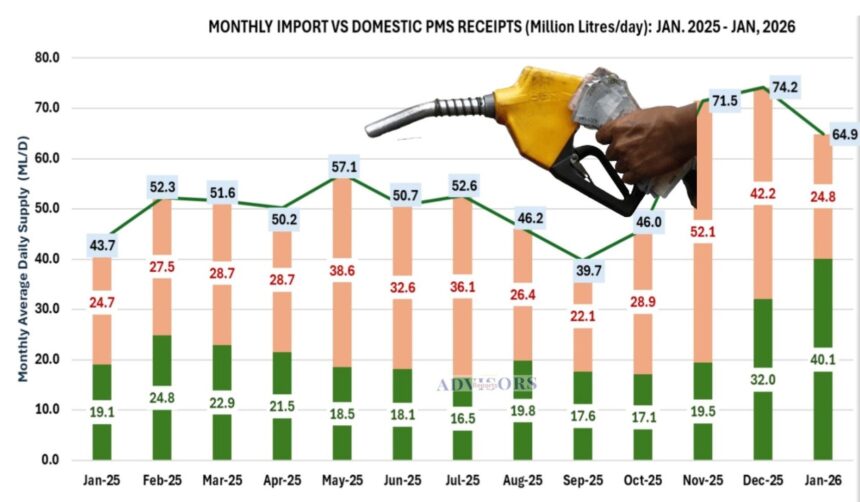
For the first time, Nigeria’s domestic petrol supply – —driven largely by output from the Dangote Refinery – averaged 40.1 million litres per day, surpassing imported volumes of 24.8 million litres per day, and bringing total daily supply to 64.9 million litres for January 2026.
This milestone was disclosed in the State of the Downstream Sector Fact Sheet for January 2026, released by the NMDPRA and obtained by Advisors Reports on Monday.
Advisors Reports’ check showed that Nigeria had historically relied on domestic refineries to meet local petrol demand, with the Port Harcourt Refinery commissioned in 1965, the Warri Refinery in 1978, and the Kaduna Refinery in 1980 providing sufficient supply through the 1970s and 1980s.
However, due to underinvestment and operational inefficiencies from the 1990s onward, domestic refining capacity fell sharply, and by the early 2000s, the country had become heavily dependent on imported petrol.
On a year-on-year basis, the January 2026 figure total average daily supply to 64.9 million litres is substantially higher than January 2025, when total average daily supply stood at 43.7 million litres, comprising 24.7 million litres per day of imports and 19.1 million litres per day from domestic sources.
On a month-to-month basis, imported fuel volumes peaked at an average of 53.1 million litres per day in November 2025, before declining to 42.2 million litres per day in December and dropping further to 24.8 million litres per day in January 2026.
In contrast, domestic supply—which had averaged between 19 million and 24.8 million litres per day from January to November 2025—rose sharply to 32.0 million litres per day in December.
It later climbed again to 40.1 million litres per day in January 2026, as the Dangote Refinery ramped up production.
The increase followed the refinery’s achievement of its highest throughput of about 570,000 barrels per day as of 20 January 2026, after its crude distillation unit resumed operations following weeks of maintenance.
Advisors Reports gathered that the upward trend in domestic supply of petrol is expected to continue, supported by planned de-bottlenecking works designed to raise the Dangote refinery’s capacity from 650,000 barrels per day to 700,000 barrels per day, with full restoration and optimisation projected to further strengthen output levels.
Despite improved local production, the NMDPRA’s data further showed that total domestic supply in January 2026 declined to 64.9 million litres per day from 74.2 million litres per day in December 2025, reflecting lower consumption following the Christmas and New Year festivities.
Petrol consumption—measured by average truck-out volumes—also dropped from 63.7 million litres per day in December 2025 to 60.2 million litres per day in January 2026.
The fact sheet further noted that days of sufficiency stock increased by 13% between December 2025 and January 2026, supported by stronger domestic refining performance, while marine stock levels declined due to reduced import activity.
Meanwhile domestic refining supply in Nigeria, rose from 32 million litres per day to 40.1 million litres per day in January, driven by improved operational efficiency at the Dangote facility, which operated at an average capacity utilisation of 61.27%.
The refinery therefore delivered 40.1 million litres per day, compared with a projected domestic supply target of 75 million litres per day for the period.