
… to deliver prosperity to millions of Nigerians
Ademisoye Precious
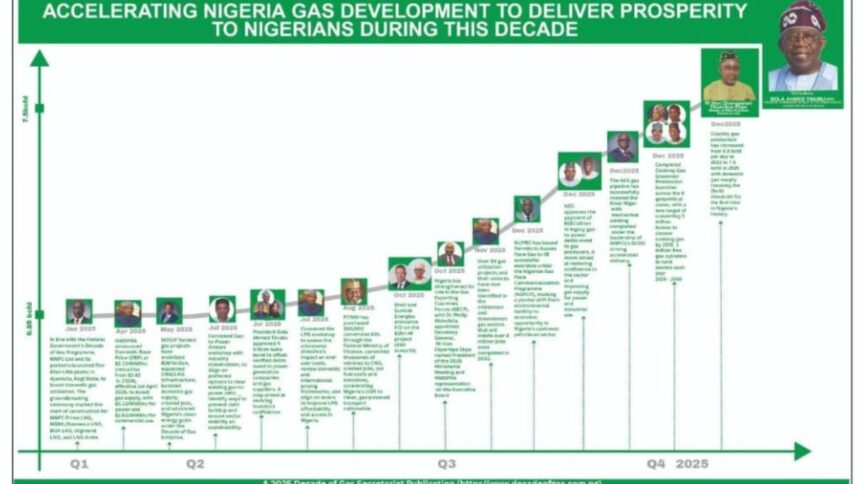
Nigeria’s Decade of Gas Programme has gained strong momentum between 2023 and 2025, with stakeholders aligning with President Bola Ahmed Tinubu’s administration to fast-track the country’s transition into a gas-powered economy by 2030.
This was disclosed in a statement issued by the Decade of Gas Secretariat and obtained by Advisors Reports at the weekend.
The programme, according to the statement, has recorded significant acceleration under President Bola Ahmed Tinubu’s administration, driven by the leadership of the Minister of State for Petroleum Resources (Gas), Rt. Hon. Ekperikpe Ekpo.
The Secretariat revealed that remarkable progress has been recorded through coordinated stakeholder efforts, with gas production rising from 6.8bcfd in 2023 to about 7.5bcfd in 2025 and domestic gas supply crossing the 2bcfd mark for the first time in Nigeria’s history.
This was supported by over 1bcfd of additional volumes unlocked through final investment decisions and firm gas supply agreements, alongside the restoration of export volumes to 2021 levels.
“Confidence in the gas-to-power segment has also improved following presidential approval for the settlement of about ₦185 billion in legacy debts owed to gas producers, while renewed upstream investor confidence has been demonstrated by three major Final Investment Decisions—Iseni, Ubeta and HI—mobilising over $2 billion toward a $30 billion investment target by 2030.
“On the global stage, Nigeria strengthened its gas diplomacy by securing key leadership positions within the Gas Exporting Countries Forum, even as affordability was reinforced through a reduction in the 2025 domestic gas base price from $2.42/mbtu to $2.13/mbtu,” the statement revealed.
The Secretariat further noted advances in domestic LPG expansion through policy directives to boost production, grassroots penetration programmes targeting women nationwide, and the completion of groundwork for a one-million-homes-per-year clean cooking initiative from 2026.
Significant progress was recorded in the midstream and downstream segments, with approval secured and funds disbursed under the Midstream and Downstream Gas Infrastructure Fund to support over 20 critical gas projects across the value chain.
In addition, NNPCL achieved key pipeline milestones on the AKK and ELPS networks, while more than 50 gas utilisation projects have been identified, with the potential to generate over four million jobs by 2030.