
…five approved offtakers to capture flare gas for power, industrial use, LPG, CNG
Oredola Adeola
The NNPC/Heirs Energies OML 17 Joint Venture has emerged as the first operator to commence agreement-signing and structured commercial execution for Nigeria’s Gas Flare Commercialisation Agreements under both the NGFCP and approved non-NGFCP frameworks.
This milestone advances a broader commercialisation and environmental-stewardship agenda, enabling flare-gas volumes across OML 17 to be captured and utilised for power generation, industrial applications, LPG and CNG.
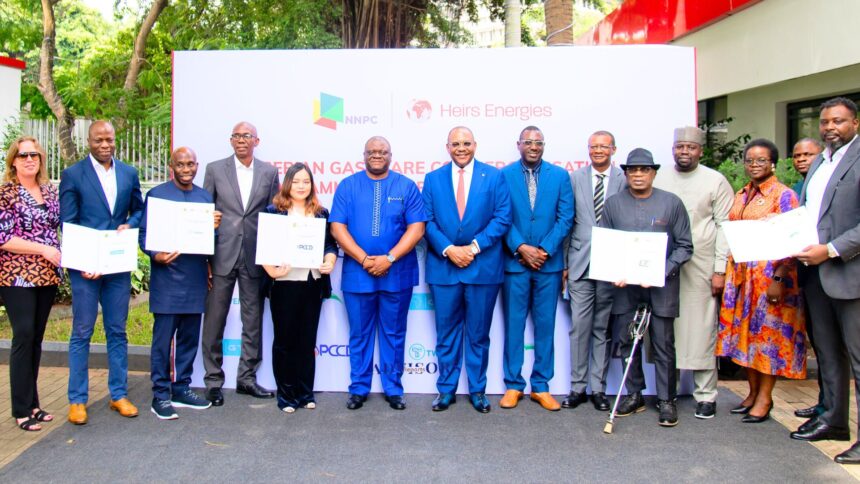
The NGFCP and non-NGFCP flare-gas commercialisation signing ceremony for OML 17, attended by the Nigerian Upstream Petroleum Regulatory Commission (NUPRC), the Nigerian National Petroleum Company Limited (NNPC) / NUIMS, and five designated gas-offtake firms was held in Lagos.
The ceremony marks a significant transition from regulatory approvals to structured commercial execution, enabling flare gas volumes across OML 17 to be captured and deployed for productive use, including power generation, industrial applications, LPG and CNG, in alignment with Nigeria’s gas development priorities and energy- transition objectives.
The agreements bring together Heirs Energies, as operator of the OML 17 Joint Venture, and approved flare gas offtakers – AUT Gas, Twems Energies, Gas & Power Infrastructure Development Limited (GPID), PCCD and Africa Gas & Transport Company Limited (AGTC) – under frameworks designed to eliminate routine flaring while converting previously wasted resources into economic value.
Engr. Seyi Omotowa, Chief Upstream Investment Officer of NUIMS, representing NNPC Limited, in his statement, described the milestone as a practical demonstration of Nigeria’s commitment to gas-based development.
“For us at NNPC Limited and NUIMS, flare gas commercialisation is not a compliance exercise; it is a strategic pathway to improving energy availability, deepening gas-based industrialisation and strengthening Nigeria’s position as a responsible energy producer.
“OML 17 has become a practical model of this vision, moving decisively from approval to delivery.”
He commended Heirs Energies for disciplined execution and investment, noting that the JV continues to set benchmarks for operational delivery and gas development within Nigeria’s upstream sector.
Engr. Gbenga Komolafe, Commission Chief Executive NUPRC represented at the event, reaffirmed the Commission’s support for the project, describing flare gas commercialisation as a cornerstone of Nigeria’s decarbonisation pathway under the Petroleum Industry Act (PIA) 2021.
“This ceremony demonstrates Heirs Energies’ commitment to eliminating routine gas flaring across OML 17 and aligns fully with the Commission’s Gas Flare Commercialisation Programme and national energy and emission-reduction objectives,” the NUPRC representative said.
Osa Igiehon, Heirs Energies’ Chief Executive Officer, on his part, noted that the agreements reflect the company’s broader gas-led strategy and brownfield excellence approach, focused on creating long-term value for Nigeria. “Gas sits at the heart of Nigeria’s development journey.
“Through disciplined investment, partnership with regulators and credible offtakers, and a clear execution focus, we are converting waste into value, strengthening domestic energy supply and supporting responsible operations across OML 17,” he said.
Advisors Reports gathered that the NGFCP and Non-NGFCP flare gas projects build on recent operational progress by the OML 17 Joint Venture, including a significant increase in gas delivery to the domestic market through brownfield interventions and infrastructure optimisation.
The company stated that the JV has also continued to deepen its host-community partnerships through targeted healthcare interventions, education support and skills-development programmes across its areas of operation.
The OML 17 NGFCP initiative reinforces Nigeria’s position as a gas-led economy, supporting domestic power generation, industrial growth and responsible resource development while advancing the country’s energy-transition objectives.